The Himalayan 750 comparison begins with Royal Enfield’s planned late-2026 or early-2027 Interceptor 750, followed by the Himalayan 750 in mid-2027, with both models projected to start at around ₹3,50,000 in India.
These details are based on leaks and supply-chain reports, not yet officially confirmed by Royal Enfield. Royal Enfield is developing a new 750 cc motorcycle platform under Siddhartha Lal and Chief of Design Mark Wells. The two motorcycles are expected to share a newly developed parallel-twin engine, but their different chassis purposes will create a clear divide between retro road riding and adventure touring.
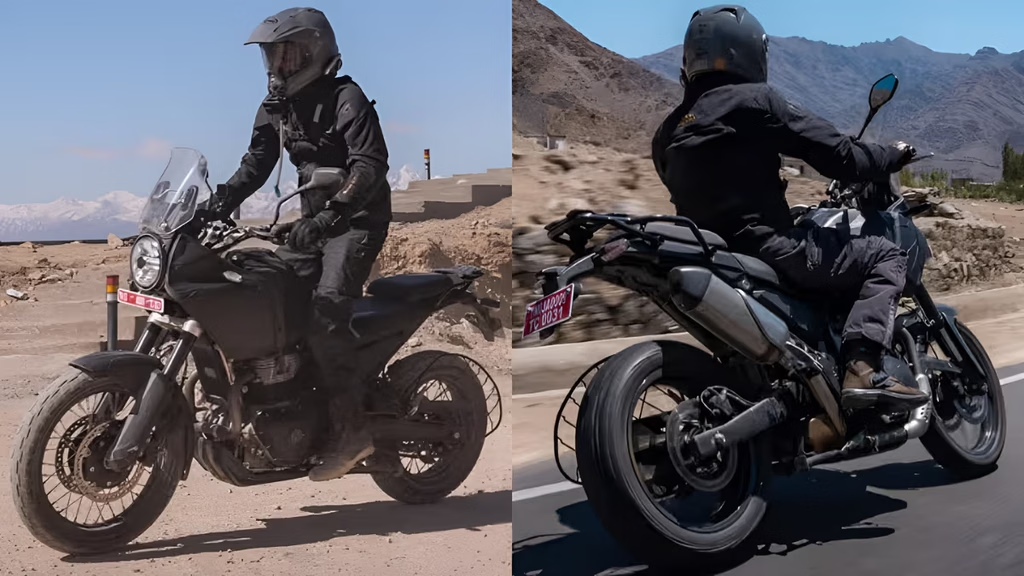
Royal Enfield Himalayan 750 Comparison: The Platform Takes Shape
The earliest confirmed part of this product story is the development of Royal Enfield’s larger-capacity platform. Available information places the project under Lal and Wells, indicating that the company wants to move beyond its existing 650 cc twin-cylinder family without abandoning its classic design identity.
The estimated launch order is significant. The Interceptor 750 is expected first, in late 2026 or early 2027, while the Himalayan 750 is slated for mid-2027. That sequence gives Royal Enfield an opportunity to establish the engine in a road-focused motorcycle before adapting it for longer-distance adventure use. The new models extend the company’s existing Royal Enfield 750cc development story. They also sit above the current 650 cc range covered in our earlier Royal Enfield 650 comparison.
Himalayan 750 And Interceptor 750 Specs Compared
The Himalayan 750 and Interceptor 750 are expected to use a parallel-twin engine displacing approximately 750 cc. Projected output sits between 45 and 55 horsepower, while torque could reach approximately 60 to 65 Nm.
| Specification | Himalayan 750 | Interceptor 750 |
|---|---|---|
| Engine type | Parallel-twin | Parallel-twin |
| Displacement | Approximately 750 cc | Approximately 750 cc |
| Expected power | 45–55 horsepower | 45–55 horsepower |
| Expected torque | 60–65 Nm | 60–65 Nm |
| Primary role | Adventure touring | Retro-classic road riding |
The shared engine should give both models stronger highway performance than Royal Enfield’s current 650 cc motorcycles. However, identical engine figures would not make them identical motorcycles. The Himalayan 750 will require adventure-oriented suspension, greater ground clearance and a riding position suited to standing on rough surfaces, while the Interceptor 750 will prioritise road manners and approachable ergonomics.
The company’s earlier Himalayan history also shows why chassis tuning matters as much as engine output. For the Himalayan, usable torque at low and medium engine speeds could matter more than the final horsepower figure.
What The 750cc Twins Could Get Right
The Interceptor 750’s main strength should be its simpler mission. A larger twin-cylinder engine, classic styling and an expected torque band of 60–65 Nm could make it attractive to riders seeking relaxed highway travel, weekend touring and a stronger alternative to the existing 650 platform.
The Himalayan 750 would target a different buyer. Its projected torque output could help when climbing, carrying luggage or riding on loose surfaces, but the larger engine may also increase weight and mechanical complexity compared with smaller adventure motorcycles. That creates the central engineering conflict. More power can improve overtaking and touring, yet adventure riders also value balance, manageable mass and suspension control. Without official chassis specifications, the Himalayan 750 cannot be judged solely by its engine figures.
Which Royal Enfield 750 Should You Choose?
The Interceptor 750 should suit riders who spend most of their time on paved roads and want a classic motorcycle with stronger performance than the current 650 cc models. Its earlier launch window also makes it the first of the pair that buyers may realistically consider. The Himalayan 750 should be the better fit for riders planning long-distance routes across India, Europe or North America.
Its appeal will depend on suspension travel, wheel sizes, protection and luggage compatibility, none of which has been officially detailed. For now, the Interceptor 750 looks like the lower-risk product because its road-focused role is easier to define. The Himalayan 750 has the higher adventure potential, but Royal Enfield must keep the motorcycle manageable rather than simply making it larger. Royal Enfield’s Himalayan 750 comparison points to two motorcycles sharing an engine but serving different riders. The final verdict will depend on chassis specifications, equipment and official pricing. The 750 cc engine may be shared, but the Himalayan 750 and Interceptor 750 will win different roads.. For more detail, see Roadshow by CNET.
FAQs
Is the Royal Enfield Himalayan 750 officially confirmed?
Royal Enfield has not officially confirmed the full specifications, pricing or launch schedule for the Himalayan 750.
When could the Interceptor 750 launch in India?
The Interceptor 750 is estimated to arrive in late 2026 or early 2027.
How powerful could the 750 cc Royal Enfield engine be?
The engine is projected to produce around 45–55 horsepower and approximately 60–65 Nm of torque.
Which motorcycle is better for touring?
The Himalayan 750 should be better suited to mixed-surface adventure touring, while the Interceptor 750 should favour paved-road touring.
Was this article helpful?
Your feedback directly improves future articles on this site.