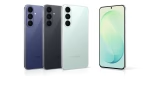
Could a single device finally replace both your phone and your tablet? Samsung seems to think so — and with the unveiling of its rollable display smartphone in early 2026, the South Korean giant is making its boldest hardware bet in years. As someone who has tracked Samsung’s display ambitions since the original Galaxy Fold, this feels different. It isn’t just a concept.
It’s a shipping product, and the specs are genuinely impressive. For context on where display innovation is heading more broadly, our coverage of Indian tech innovators unveiling biodegradable smartphone batteries in March 2026 shows just how fast the hardware space is evolving right now.
Table of Contents
Why the Rollable Form Factor Is Having Its Moment?
Foldables had their run. Samsung sold millions of Galaxy Z Fold and Flip units, but the hinge crease never fully disappeared — literally or figuratively. Consumers tolerated it. They didn’t love it.
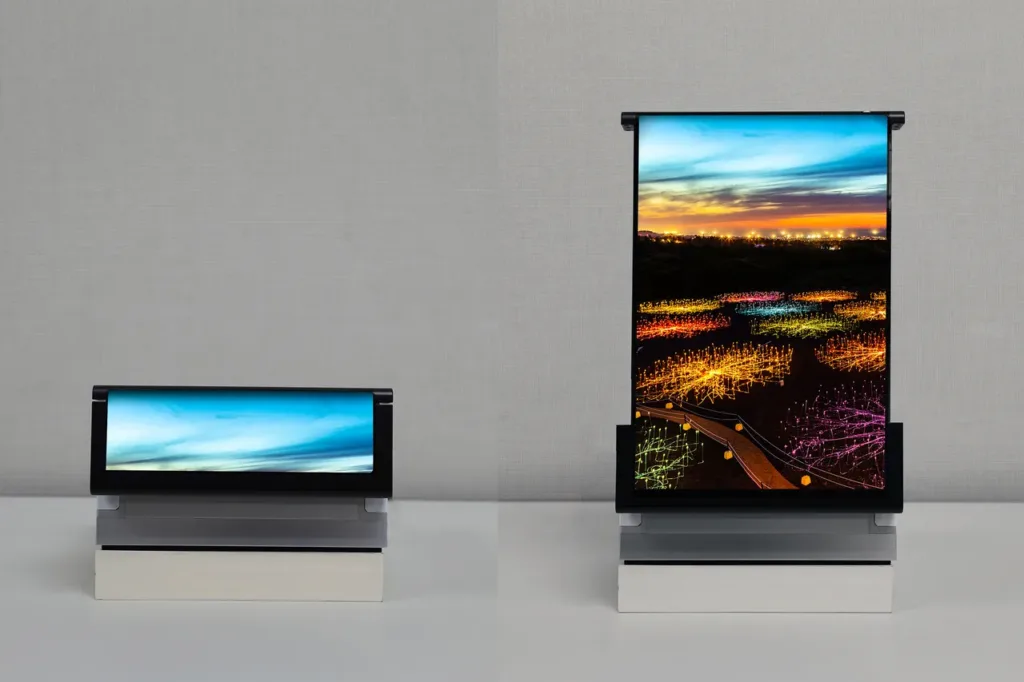
Rollable displays solve the crease problem by eliminating the fold entirely. The screen extends from a cylindrical housing, keeping the panel in near-constant gentle curvature rather than a sharp 180-degree bend. OLED panels handle this far better over time. Samsung’s display division, SDC, has reportedly been stress-testing rollable panels through over 200,000 extension cycles — roughly equivalent to 10 years of daily use. That durability milestone is what finally gave Samsung the confidence to ship this commercially rather than tease it at trade shows.
Samsung Rollable Specs, Features & Price
Here’s the thing — the specs sheet on this device reads like a wish list someone forgot to edit.
The Samsung rollable ships with a 6.3-inch compact display in standard mode, extending to a 7.9-inch full-screen mode with a single swipe gesture or automatic app-triggered expansion. The panel is a Dynamic AMOLED 2X with 2600 nits peak brightness and a 1-120Hz adaptive refresh rate.
Under the hood: Snapdragon 8 Elite (2025 node), 16GB RAM, and storage options of 256GB and 512GB UFS 4.0. Battery sits at 5,000mAh with 65W wired charging and 15W wireless. The camera system features a 200MP primary sensor, 50MP periscope telephoto at 5x optical zoom, and a 12MP ultrawide. Samsung has confirmed an IPX8 water resistance rating — a first for a rollable device.
Pricing starts at $1,799 / ₹1,49,999 (rumored) for the 256GB model. Availability is set for April 2026 across major markets including India, the US, and South Korea.
How It Stacks Up Against the Competition
Samsung isn’t alone in this race. Motorola previewed its own rollable concept at MWC 2025, and OPPO has been quietly filing rollable patents since 2023. But neither has shipped a retail-ready product at scale.
The closest real-world competitor right now is the Samsung Galaxy Z Fold 7, which starts at $1,599. The Fold 7 offers a more proven form factor and a larger unfolded screen at 8.0 inches, but the crease remains, and the hinge adds bulk. The rollable is actually thinner at 10.9mm in compact mode compared to the Fold 7’s 12.1mm closed thickness.
Apple’s rumoured foldable iPhone isn’t expected until late 2026 at the earliest, which gives Samsung a meaningful first-mover window in the premium flexible display segment.
Real-World Usability: Does It Actually Work?
Q: Is the Samsung rollable display durable enough for everyday use?
Based on early hands-on reports from Samsung’s press briefing, the answer is a cautious yes. The extension mechanism feels mechanical and precise — not fragile. Samsung uses a reinforced polymer film over the OLED panel rather than ultra-thin glass, which allows the flexing motion without micro-fractures. The trade-off is slightly reduced scratch resistance compared to Corning Gorilla Glass Victus 2.
Software is equally important here. Samsung’s One UI 8.1 is built specifically around the rollable paradigm. Apps like YouTube, Samsung Notes, and Google Maps auto-expand when the screen rolls out. Third-party app support, however, remains inconsistent at launch — a familiar growing pain for new form factors.
The device is genuinely pocketable in compact mode. That matters more than it sounds.
Quick Comparison
| Device | Key Spec | Price | Best For | Rating |
|---|---|---|---|---|
| Samsung Rollable (2026) | 6.3″–7.9″ rollable AMOLED, Snapdragon 8 Elite | $1,799 / ₹1,49,999 | Power users who want phone + tablet in one | 9.0/10 |
| Samsung Galaxy Z Fold 7 | 8.0″ inner display, Snapdragon 8 Elite | $1,599 / ₹1,34,999 | Proven foldable experience with mature software | 8.5/10 |
| OPPO Find N5 | 8.12″ inner display, Dimensity 9400 | $1,499 / ₹1,24,999 | Slim foldable with strong camera performance | 8.0/10 |