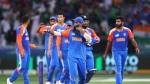
In one of the most dramatic matches in T20 World Cup 2026 history, South Africa survived a monumental scare from Afghanistan to emerge victorious after two Super Overs in Ahmedabad on February 11, 2026. After regulation time ended with both teams locked at 187, the first Super Over produced an identical 17-17 tie before South Africa finally prevailed 23-19 in the second Super Over, despite Rahmanullah Gurbaz’s heroic 84 off 42 balls and three consecutive sixes in the final Super Over.
Table of Contents
Match Summary
The Group D encounter between two teams fighting for survival in the tournament’s group of death delivered unprecedented drama. South Africa posted 187 for 6 after twin half-centuries from Ryan Rickelton and Quinton de Kock, only to see Afghanistan tie the score in the final over through a combination of no-balls and running errors. Two Super Overs followed, with Gurbaz hitting six sixes across both additional overs before falling agonizingly short, his final shot flying straight to David Miller at point when any other direction would have forced a third Super Over.

Match Scorecard
| Team | Regulation Score | 1st Super Over | 2nd Super Over |
|---|---|---|---|
| South Africa | 187/6 (20 overs) | 17 | 23 |
| Afghanistan | 187 (19.4 overs) | 17 | 19 |
Result: Match tied, South Africa won the 2nd Super Over
Player of the Match: Lungi Ngidi (3/26)
Cricinfo’s MVP: Lungi Ngidi (106.15 points)
Venue: Narendra Modi Stadium, Ahmedabad
Date: February 11, 2026
Historic Significance: First double Super Over in T20 World Cup history
First Innings: South Africa’s Batting (187/6 in 20 Overs)
Early Setback and Spin Challenge
South Africa’s innings began under immediate pressure from Afghanistan’s skilled left-arm quick Fazalhaq Farooqi, who swung the ball both ways in testing opening conditions. Farooqi’s superb start yielded the wicket of Aiden Markram, dismissed by a clever slower ball that exposed two left-handed batsmen to Afghanistan’s offspinners. This early breakthrough left South Africa at 12 for 1 after four overs, facing a spin-heavy Afghan attack on a pitch offering grip and turn.
The wicket brought together Quinton de Kock and Ryan Rickelton, two left-handers whose body shapes when playing shots can appear remarkably similar. South Africa have historically found it difficult to accommodate both in the same XI, but in this crucial T20 World Cup 2026 encounter, they proved why both belonged in the lineup.
De Kock and Rickelton’s Counter-Attack
Quinton de Kock, despite averaging only 6.94 runs per over against spin throughout his T20 career, broke the shackles that Afghanistan’s spinners had imposed. His aggressive intent set the tone for what would become a match-defining partnership. However, it was Rickelton who elevated the assault to another level, matching everything de Kock attempted with even more brute force.
Left-arm wristspinner Noor Ahmad, brought into the Afghan XI as their only change, bore the heaviest punishment. De Kock welcomed him with a six over long-on from his very first delivery. Two balls later, Rickelton launched an even bigger maximum, establishing immediate dominance over the young spinner.
The partnership flourished through clever shot selection and fearless execution. Both batsmen reached their half-centuries in the 11th over, bowled by Mujeeb Ur Rahman. Rickelton’s fifty came off just 23 balls, while de Kock required 34 deliveries. By the time the duo had propelled South Africa to 126 in the 13th over, they had added 114 runs in 10.1 overs, completely transforming the complexion of the innings.
Rashid Khan’s Fightback
Captain Rashid Khan, despite being taken for 21 runs in his first two overs, orchestrated Afghanistan’s comeback with a pivotal over that changed the match dynamics. Rashid struck twice in quick succession, dismissing both Rickelton and de Kock to reach the milestone of 699 T20 wickets. The double-wicket over effectively started a new game, with South Africa suddenly vulnerable at 126 for 3.

Afghanistan’s strategy of offering batsmen minimal pace through their spin-heavy attack proved effective in restricting South Africa’s lower order. Only a couple of powerful blows from Marco Jansen in the death overs provided late impetus. South Africa managed just 63 runs off the final 7.3 overs, a testament to Afghanistan’s disciplined bowling through the middle and death phases.
South Africa Batting Performance
| Batsman | Runs | Notable Performance |
|---|---|---|
| Ryan Rickelton | 61 | 23-ball half-century, destructive against spin |
| Quinton de Kock | 59 | 34-ball fifty, broke shackles against spin |
| Marco Jansen | – | Late boundaries in death overs |
Afghanistan Bowling Performance
| Bowler | Overs | Runs | Wickets | Notable Performance |
|---|---|---|---|---|
| Rashid Khan | 4.0 | 28 | 2 | Two wickets in one over, 699 T20 wickets |
| Azmatullah Omarzai | 4.0 | 41 | 3 | Consistent wicket-taker |
| Fazalhaq Farooqi | 4.0 | – | 1 | Excellent opening spell with new ball |
| Noor Ahmad | 4.0 | – | – | Targeted heavily by both openers |
First Innings Analysis
South Africa’s total of 187 for 6 appeared formidable after the de Kock-Rickelton partnership, but the final seven overs suggested Afghanistan’s spinners had found the formula to restrict scoring on the Ahmedabad pitch. The total seemed defendable through South Africa’s tall pace bowlers with their canny changes of pace, but nobody anticipated the extraordinary individual effort that would follow from Rahmanullah Gurbaz.
Second Innings: Afghanistan’s Chase (187 in 19.4 Overs)
Gurbaz’s Explosive Start
Rahmanullah Gurbaz announced his intentions from the first over, beginning with a gentle full toss from Lungi Ngidi before systematically dismantling the South African bowling attack. His assault transcended conventional cricket, as he took down not just loose deliveries but the best balls South Africa’s bowlers could produce.

Gurbaz backed away to ramp an accurate short ball from Marco Jansen for six, showcasing remarkable improvisation. When Kagiso Rabada entered the attack, Gurbaz upper-cut his first delivery over deep third for an even bigger maximum. George Linde, the tall left-arm spinner crucial to South Africa’s plans, suffered the same fate on his very first ball—Gurbaz made room and launched him down the ground for six over long-off.
Ngidi and Maharaj Apply Pressure
Lungi Ngidi, the eventual Player of the Match, recovered superbly from his expensive 13-run first over. Dealing almost exclusively in slower balls even with the new ball, Ngidi’s variations proved devastatingly effective. One slower delivery dipped under Ibrahim Zadran’s bat, while another drew a return catch from Gulbadin Naib, which Ngidi took with a full-length dive to his right.

Keshav Maharaj excelled alongside Ngidi, delivering outstanding figures of 4-0-27-1 despite two harsh wide calls. While Gurbaz successfully dominated Linde, he found Maharaj far more challenging. The left-arm spinner conceded no boundaries in his first three overs, maintaining pressure through accuracy and subtle variations.
The Turning Point
When Gurbaz finally managed to hit a six off Maharaj, the spinner responded immediately with a slow, wide delivery. Gurbaz edged it to backward point, where Linde completed a diving catch. Maharaj’s dismissal of Afghanistan’s dangerman seemed to shift momentum decisively toward South Africa.
The IPL Trio’s Resistance
With Gurbaz departed, the responsibility fell on Afghanistan’s IPL trio of Rashid Khan, Mohammad Nabi, and Azmatullah Omarzai, with the asking rate hovering around 10 runs per over for the final seven overs. Ngidi’s slower balls were offset by Jansen’s pace, which Omarzai struck for two boundaries.
Linde claimed Nabi’s wicket bowling over the wicket, but Rashid immediately swept him for four to maintain Afghanistan’s hopes. Rabada executed slower balls and yorkers with near-perfection in the 17th over, yet Rashid still managed two boundaries—pulling a slower ball between cow corner and deep square leg, then squeezing a yorker past point.
Tristan Stubbs caught Omarzai at the edge of long-on in the 18th over, tossing the ball up, stepping over the boundary, and returning to complete the catch legally. David Miller’s diving catch in the 19th over sent Rashid back for 20 off 12 balls. With 19 needed off nine balls and only tailenders remaining, South Africa appeared certain victors.
The Dramatic Finale
Marco Jansen either missed his yorker or became greedy for a lower-order wicket, bowling an on-pace slot ball to Noor Ahmad. The tailender launched it for six, suddenly reviving Afghanistan’s hopes. A run-out off the final ball of the over provided temporary relief for South Africa.
The last over began with Noor caught in the off side, but Rabada had overstepped. Incredibly, Ahmad smoked another six off a slower short ball. Another no-ball made it a cruise for Afghanistan—they needed just two runs off three balls, with the fourth ball a free hit. Confusion over running between wickets on the free hit led to an attempted second run. A wide throw allowed Rabada to run out Farooqi, tying the match at 187-187.
Afghanistan Batting Performance
| Batsman | Runs | Notable Performance |
|---|---|---|
| Rahmanullah Gurbaz | 84 | Off 42 balls, destructive innings |
| Rashid Khan | 20 | Off 12 balls, crucial late hitting |
| Azmatullah Omarzai | – | Boundaries against Jansen |
| Noor Ahmad | – | Two sixes in final over |
South Africa Bowling Performance
| Bowler | Overs | Runs | Wickets | Notable Performance |
|---|---|---|---|---|
| Lungi Ngidi | 4.0 | 26 | 3 | Player of the Match, excellent slower balls |
| Keshav Maharaj | 4.0 | 27 | 1 | Outstanding figures, dismissed Gurbaz |
| Kagiso Rabada | 4.0 | – | – | Two no-balls in final over |
| Marco Jansen | 4.0 | – | – | Expensive final over |
First Super Over: 17-17 Tie
Afghanistan’s Batting
Azmatullah Omarzai rose to the occasion, hitting a six and two fours off Lungi Ngidi to set South Africa a challenging target of 18 runs. Gurbaz didn’t need to reprise his heroics from regulation time as Omarzai’s assault gave Afghanistan a strong position.
South Africa’s Response
Fazalhaq Farooqi nearly redeemed himself for the regulation-time run-out by dismissing Dewald Brevis, leaving South Africa needing 11 off three balls. Cruelly for Farooqi, a perfect yorker squirted off the bottom edge for four. He then missed his yorker on the final ball, allowing Tristan Stubbs to hit a flat six over the short straight boundary, tying the Super Over at 17-17.
Second Super Over: 23-19 (South Africa Win)
South Africa’s Batting
Omarzai, thrust into bowling the second Super Over after his batting heroics in the first, faced a brutal assault. Stubbs struck the first ball for six, and Miller demolished errors in length for two more sixes, setting Afghanistan a target of 24 runs.
Afghanistan’s Chase
South Africa surprised everyone by handing the ball to Keshav Maharaj, their second-best bowler in regulation time but also a spinner. Afghanistan split their successful first Super Over pairing, sending Mohammad Nabi to face the spin, but he grabbed a two-ball duck.
Gurbaz refused to surrender. First ball: short, flat delivery, heaved over long-off for six. Three sixes needed off three balls. Second ball: flighted and slow, dispatched for another six. Two sixes needed off two balls. Third ball: fired in on a length, heaved over wide long-on for yet another maximum.
With six needed off the last ball for a third Super Over, Maharaj bowled a wide, making it five needed. He then went wide again on the final delivery. Gurbaz sliced it powerfully, but hit it straight to David Miller at point. A couple of meters either side, and Afghanistan would have had another opportunity. Instead, heartbreak.
Super Over Statistics
| Super Over | South Africa | Afghanistan | Result |
|---|---|---|---|
| First | 17 (Stubbs 6*, Brevis out) | 17 (Omarzai’s assault) | Tie |
| Second | 23 (Stubbs 6, Miller 12*) | 19 (Gurbaz 18, Nabi 0) | SA Win |
Match-Winning Performance: Lungi Ngidi
| Category | Performance |
|---|---|
| Bowling | 3/26 in 4 overs |
| Variations | Slower balls primarily |
| Wickets | Zadran, Naib, plus one more |
| Cricinfo MVP | 106.15 points |
| Impact | Recovered from expensive first over |

Lungi Ngidi’s ability to recover from a 13-run first over and bowl consistently effective slower balls proved decisive in a match of fine margins. His three wickets included crucial middle-order dismissals that kept Afghanistan’s chase in check during regulation time.
Read More: T20 World Cup 2026: Pakistan Spinners and Farhan’s Brilliance Secure Victory Over USA
FAQs
What was the final result of the Afghanistan vs South Africa T20 World Cup 2026 match?
The match was tied at 187-187 after regulation time. After the first Super Over also tied at 17-17, South Africa won the second Super Over 23-19 to claim victory in the T20 World Cup’s first-ever double Super Over.
How many runs did Rahmanullah Gurbaz score in the match?
Rahmanullah Gurbaz scored 84 runs off 42 balls in regulation time, and added 18 more runs (three sixes) in the second Super Over, despite ultimately finishing on the losing side.
Who won the Player of the Match award?
Lungi Ngidi won the Player of the Match award for his figures of 3 for 26 in 4 overs, recovering brilliantly from an expensive first over to deliver crucial wickets through regulation time.
Where was the Afghanistan vs South Africa T20 World Cup 2026 match played?
The match was played at the Narendra Modi Stadium in Ahmedabad, India, on February 11, 2026.
What were the scores in both Super Overs?
In the first Super Over, both teams scored 17 runs, resulting in another tie. In the second Super Over, South Africa posted 23 runs, while Afghanistan managed 19 runs, with Rahmanullah Gurbaz hitting three consecutive sixes before being caught on the final ball.