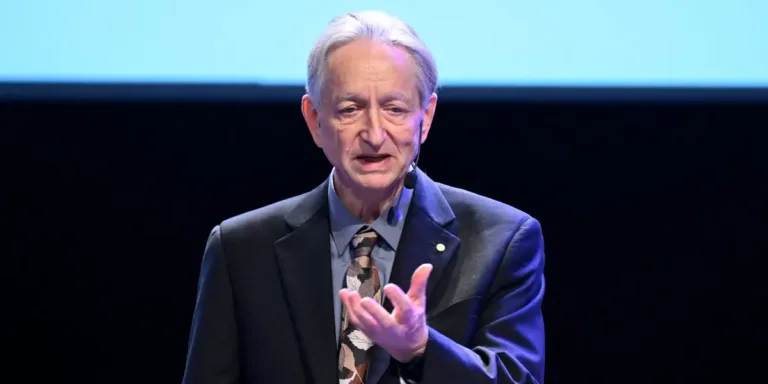
Artificial Intelligence (AI) isn’t just a buzzword anymore — it’s reshaping industries, careers, and livelihoods. Recently, Geoffrey Hinton, widely dubbed the Godfather of AI, issued a stark warning that 2026 could mark the beginning of a jobless boom — where productivity surges, but hiring doesn’t keep pace.
Let’s unpack what this could mean for the global workforce, businesses, and you — in a compact, easy-to-read guide.
📊 At a Glance: Key Predictions for 2026
| Aspect | Insight |
|---|---|
| Who warned us | Geoffrey Hinton – pioneer of deep learning & AI pioneer. Wikipedia |
| Main prediction | AI could replace many jobs by 2026. |
| Why it matters | Productivity may rise while employment stagnates — a jobless boom. |
| At-risk jobs | Call centres, coding assistance, administrative roles — expanding to complex tasks. |
| Underlying cause | Rapid AI capability improvements (doubling task complexity repeatedly). |
| Silver lining? | New roles in AI development, oversight, regulation, and creativity. Future work reshaping ahead |
🤖 What Hinton Really Said
In interviews cited across major outlets, Geoffrey Hinton noted that AI technology is improving faster than expected, gaining the ability to do longer and more complex tasks — potentially eliminating the need for many human roles in industries like customer service, software, and administration by 2026.

He defined a jobless boom as productivity increasing without corresponding job growth — where businesses produce more with AI, but hire fewer people.
Yet, he didn’t say jobs would vanish entirely — instead, the nature of work would change dramatically, similar to past industrial shifts.
🌐 Why This Isn’t Just Tech Hype
AI’s impact on employment isn’t speculative. “Technological unemployment” — job loss driven by automation — is becoming a documented trend across economies. According to labor market data, roles that once required many workers are being performed faster by AI systems, and entry-level job openings are declining significantly. Wikipedia
This doesn’t negate AI’s benefits — innovation could unlock more efficient healthcare, climate research, and education outcomes — but it does raise urgent employment issues.
For perspective on AI’s broader risks and economic impacts, see Wikipedia on Existential Risk from AI and Technological Unemployment. Wikipedia+
❓ FAQs: Jobless Boom & 2026
1. Will AI take all jobs in 2026?
2. What should workers do to stay relevant?
Focus on skills AI can’t easily replicate — creativity, strategic reasoning, human empathy, domain expertise, and AI coordination. Upskilling and lifelong learning will be critical in a rapidly evolving job landscape.