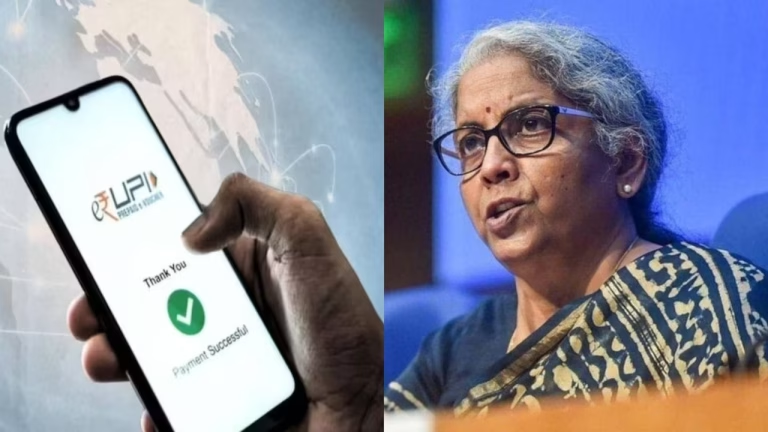
If your feed has been flooded with panic about UPI suddenly charging you for sending money to friends, take a breath — that’s not happening. Amid growing confusion around a recent legal amendment, the government has stepped in with a clear clarification: UPI remains completely free for regular users, and any future charges will apply only to a narrow slice of merchant transactions.
Here’s a breakdown of what’s changing, what isn’t, and why this debate started in the first place.
Table of Contents
UPI MDR Clarification: Key Facts
| What | Status |
|---|---|
| Person-to-person (P2P) UPI transfers | Remain completely free, regardless of amount |
| Small merchant payments (zero-MDR framework) | Remain free for eligible small merchants |
| MDR charge | Applies only within the merchant payment ecosystem |
| Who pays MDR, if introduced | Merchants, not customers |
| Government instruction to banks | Merchants must not pass MDR costs onto customers |
| Is MDR a tax or government fee? | No — it’s distributed among digital payment ecosystem participants |
| Final decision on rate/threshold | Pending, to be set by the UPI and Services Steering Committee (NPCI) |
Why This Clarification Was Needed
The confusion traces back to a recent amendment to the Payment and Settlement Systems Act, 2007, passed as part of the Taxation and Other Laws (Amendment) Bill, 2026. The amendment gives the government an enabling provision to permit charges on UPI and other electronic payment modes in the future — which understandably sparked concern that ordinary users might soon start paying to send money via UPI.

The Finance Ministry moved quickly to shut down that fear, confirming that all P2P UPI transactions will stay free, and that there’s no blanket MDR being introduced on merchants either. If any MDR is eventually applied, it will be limited to a specific set of merchant transactions above a certain threshold, and at a nominal rate — far lower than what’s currently charged on debit or credit card transactions.
What Is MDR, Exactly?
MDR, or Merchant Discount Rate, is essentially a small processing fee charged within the payments ecosystem — think banks, payment service providers, and networks — to help sustain the infrastructure behind digital transactions. It is not a tax, and it isn’t collected by the government. The push for a sustainable MDR framework stems from UPI’s massive scale: in July 2026 alone, the system processed over 23 billion transactions worth nearly ₹30 lakh crore, a volume that demands continuous investment in cybersecurity, fraud prevention, and infrastructure upgrades. This mirrors how large-scale digital payment systems, similar to those built around global standards like ISO 20022, require ongoing technical investment to remain secure and reliable at scale.
The Bottom Line for Everyday Users
If you’re sending money to a friend, paying your local vegetable vendor, or making a small UPI payment to a shop — nothing changes for you. The eventual MDR framework, if and when it’s finalized, is designed to target larger merchant transactions, not everyday consumer use.
For more updates on India’s digital payments landscape and fintech policy changes, check out our tech and business coverage on TechnoSports.
FAQs
Q1. Will UPI transactions become chargeable for regular users?
No. All person-to-person UPI transactions remain completely free, regardless of the transaction amount.
Q2. Who will pay MDR if it’s eventually introduced?
MDR, if implemented, will apply only to select merchant transactions above a certain threshold — not to customers making payments.