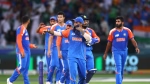
It was 0 for 0 and four balls had elapsed. Sanju Samson had announced himself in the grandest possible manner over his previous two innings, but this was a new day, the biggest day of them all, and he was facing an opposition he had struggled against only a few weeks earlier, so badly that he had lost his place in the team as a result. Matt Henry was nipping the new ball around, and had already gone up once in appeal for lbw.

Then Samson stepped out of his crease and swatted Henry over the long-on boundary.
Of course he did. This was Samson’s fifth match of this T20 World Cup. This was the fourth time he had had the opportunity to be on strike in the first over. He had hit a first-over six on each previous occasion, and he had done it again. This is Samson. This is how he bats. Why would he bat any differently just because it’s the final?
| India’s Top Three | Performance |
|---|---|
| Combined runs | 195 off 92 balls |
| Samson | First-over six (4th consecutive match) |
| Abhishek | 52 off 21 (18-ball fifty, fastest of tournament) |
| Kishan | Dominated Santner (21 off 10) |
Table of Contents
Abhishek’s Unconventional Masterclass
Facing the third ball of the second over, Abhishek Sharma did something he almost never does. He played a genuine forward defensive. It had taken a tournament of outrageous lows, particularly against offspin, for it to have come to this.
He wasn’t going to bat like this for too long. He wouldn’t be Abhishek if he did. On this day, it became clear that he wasn’t in form – not the kind we are used to seeing from him, with his movements decisive and his body always positioned perfectly to allow full extension of the arms and unfettered flow of bat through ball. On this day, he was in the runs but not entirely in form.

He reached his fifty in 18 balls, the quickest half-century of this tournament, but only his third-quickest in T20Is. He stepped out, made room, sent the ball flying into and over the off side. When Jacob Duffy stacked that side and slanted short-of-length balls away, he stepped across and swatted over midwicket. He did all this even as he struggled to middle the ball, skewing and slicing more often than nailing his hits. He lost his shape on occasions and sent edges flying to the fine third boundary. Miscues landed between fielders or just beyond reach of despairing dives. When he was out, his control percentage was 71.4.
When you think of great innings, you typically think of batters standing above the conditions and bowling, exuding otherworldly certainty. This was different, and great in its own way. A batter not among the runs, not middling the ball consistently, doubting himself – as he confessed post-match – and continuing to back his methods, back his shots, and keep taking on the risks he backed himself to pull off. In a World Cup final. A batter willing to sacrifice control for impact, knowing he could fall for another low score in the process.
The Offspin Equation and Batting Order Rejig
He didn’t take that risk against the offspinner, though. Glenn Phillips gave away just five runs in that over and didn’t bowl again. He wasn’t even the offspinner India would have envisioned facing. New Zealand had left out Cole McConchie, who had taken out two of South Africa’s left-hand batters in one over in the semi-finals.
Why did New Zealand not give Phillips another over? Why did they leave McConchie out? Samson being India’s other opener might have had something to do with both decisions.
Samson hadn’t been in India’s original starting XI at this World Cup. But he found a way back in thanks to all the trouble India got into in the first half, particularly when their exclusively left-handed top three came up against offspin in the powerplay. Samson was brought in to break up the left-handed sameness.
In the semi-final against England, Samson’s presence hadn’t prevented Abhishek from getting out to an early risk against an offspinner – even though he had hit Will Jacks for two fours earlier in the over. Here in the final, Abhishek had let Phillips be, deciding to leave that match-up in Samson’s hands. Samson’s presence was giving Abhishek this option.

Samson’s entry into India’s XI had another effect: shifting Ishan Kishan from opener to No. 3, and Tilak Varma from No. 3 to No. 5. This ended up solving another problem India had been facing.
Until the Super Eight match against South Africa, which they lost by 76 runs, India had the worst first-ten-overs scoring rate against spin (6.95) of all Full Member teams in this tournament.
Abhishek was falling early repeatedly, while Kishan was scoring rapidly against spin while getting out frequently (77 runs off 47 balls in the first ten overs, with four dismissals). This meant Tilak at No. 3 and Suryakumar Yadav at No. 4 were facing a lot of spin, and both were struggling to move the scoreboard. While batting in the first ten, Tilak scored 30 off 30 against spin without being dismissed, and Suryakumar 26 off 31 without being dismissed.
| India vs Spin (First 10 Overs) | Before Rejig | After Rejig |
|---|---|---|
| Scoring rate | 6.95 (worst among Full Members) | 8.64 (Super Eight onwards) |
| Average | Struggling | 36.75 (best of tournament) |
| Tilak’s role | No. 3 (30 off 30 vs spin) | No. 5 (pace-hitting role) |
| Suryakumar’s role | No. 4 (26 off 31 vs spin) | No. 4 (less spin exposure) |
| Kishan’s dismissals | 4 dismissals (77 off 47 as opener) | Facing primary spinners at No. 3 |
Samson’s entry prevented opponents from front-loading with offspin. It pushed Kishan into a role in which he was spending more time at the crease in the early middle overs, taking on the opposition’s primary spinners (who overwhelmingly bowl left-arm orthodox or legspin), giving them far less breathing room than they might have had against Tilak or Suryakumar.
On Sunday, when Mitchell Santner brought himself on to bowl his left-arm spin, Samson took no risks against him, hitting an orthodox back-cut for four but otherwise simply turning the strike over and letting Kishan take charge. Samson scored 10 off 11 balls against Santner, while Kishan took 21 off 10, slugging him for two trademark leg-side sixes. It was an unusually old-school way of distributing risk, but India probably viewed Santner as New Zealand’s main threat and thought it best not to take unnecessary chances against him.
They were unnecessary because Samson, Abhishek and Kishan were taking pretty much everyone else to the cleaners. Rachin Ravindra has been an unexpectedly potent wicket-taker at this World Cup, but India showed him no respect on this Ahmedabad featherbed, not even after he struck in his first over with a ball that would have been a wide had Abhishek not chased it.
When New Zealand dared to use Ravindra for a second over, Samson took him down with three successive sixes, all classic Samson shots: the step-hit down the ground, the merciless pull over midwicket, the inside-out launch over wide long-off.

Before that, Kishan had spanked Ravindra for back-to-back fours almost as soon as he walked in, and the first one illustrated just why India become so much more dangerous when he rather than Tilak or Suryakumar faces spin in the early middle overs. This was a good ball from Ravindra, fired into the pitch, turning into the top of the stumps, offering no room to free the arms, with plenty of protection on the leg-side boundary. It’s the staple defensive ball for spinners in the middle overs, and Kishan opened his hip to create just enough room to punch it with an almost straight bat and bisect long-on and deep midwicket.
It’s no coincidence that Samson’s entry and the consequent batting-order rejig entirely transformed India’s fortunes against spin. From that point on, India became the best-averaging team of the tournament in the first 10 overs against spin (36.75), and even if they were only in the middle of the Super Eight pack as far as scoring rate went, they were still going at 8.64, a massive improvement from their early-tournament base.
The rejig didn’t hurt India’s end-overs hitting either, with Tilak slotting seamlessly into Rinku Singh’s pace-hitting role down the order. After the rejig, Tilak faced 25 balls from fast bowlers in the death overs (17-20) and scored 62 runs, at a strike rate of 248.00. He hit seven sixes, including three off Jofra Archer in the 19th over of the semi-final in Mumbai.
The Accidental Perfection
Tilak didn’t have too much to do on Sunday. This day was almost all about Samson, Abhishek and Kishan, who between them scored 195 off 92 balls, and at one stage left viewers dreaming about 300 all over again.
This was a top three that meshed together so beautifully, complementing each other perfectly in partnerships, denying the opposition straightforward match-ups, and putting every bowler under immense pressure with their intent and range of scoring options. It looked like a top three assembled with great farsightedness, but it had come together almost by accident.
Kishan wasn’t even in India’s World Cup plans until their last series before the tournament; he may not have found a place in the XI had two events outside his control – Tilak missing that series with injury and Samson undergoing a serious form slump – not coincided with his being in the form of his life.
Samson had gone from guaranteed opener-keeper to middle-order keeper battling with Jitesh Sharma for a starting role to opener-keeper to out of the starting XI… to back in it.
Abhishek had gone from No. 1 T20I batter in the world to going through the entire group stage of this World Cup without scoring a run.
All those things had needed to happen for this top three to happen. And once it happened, magic happened, culminating in one of the greatest top-order displays ever seen in a T20 game, in the biggest T20 game of them all.
Read More: Suryakumar Yadav: The Journey of India’s T20 World Cup-Winning Captain
FAQs
How did India’s top three score in the World Cup final?
Samson, Abhishek and Kishan scored 195 off 92 balls. Abhishek reached his fifty in 18 balls (fastest of tournament), Samson hit his fourth consecutive first-over six, and Kishan dominated Santner with 21 off 10 balls.
How did Samson’s entry solve India’s spin problem?
Samson broke up the exclusively left-handed top three that struggled against offspin. His entry shifted Kishan to No. 3 where he could take on primary spinners. India went from worst first-ten-overs scoring rate against spin (6.95) to best-averaging team (36.75).
What was unique about Abhishek Sharma’s innings?
Abhishek scored 52 off 21 with only 71.4% control percentage. He wasn’t middling the ball consistently but continued backing his shots in a World Cup final, sacrificing control for impact.
How did the batting order rejig help Tilak Varma?
Tilak moved from No. 3 to No. 5, slotting into a pace-hitting role. After the rejig, he scored 62 runs off 25 balls from fast bowlers in death overs at a strike rate of 248.00, hitting seven sixes.
How did this top three come together “by accident”?
Kishan wasn’t in World Cup plans until the last series. Tilak’s injury and Samson’s form slump coincided with Kishan’s best form. Samson went from out of the XI to back in it. Abhishek went from No. 1 T20I batter to the entire group stage without scoring a run.