
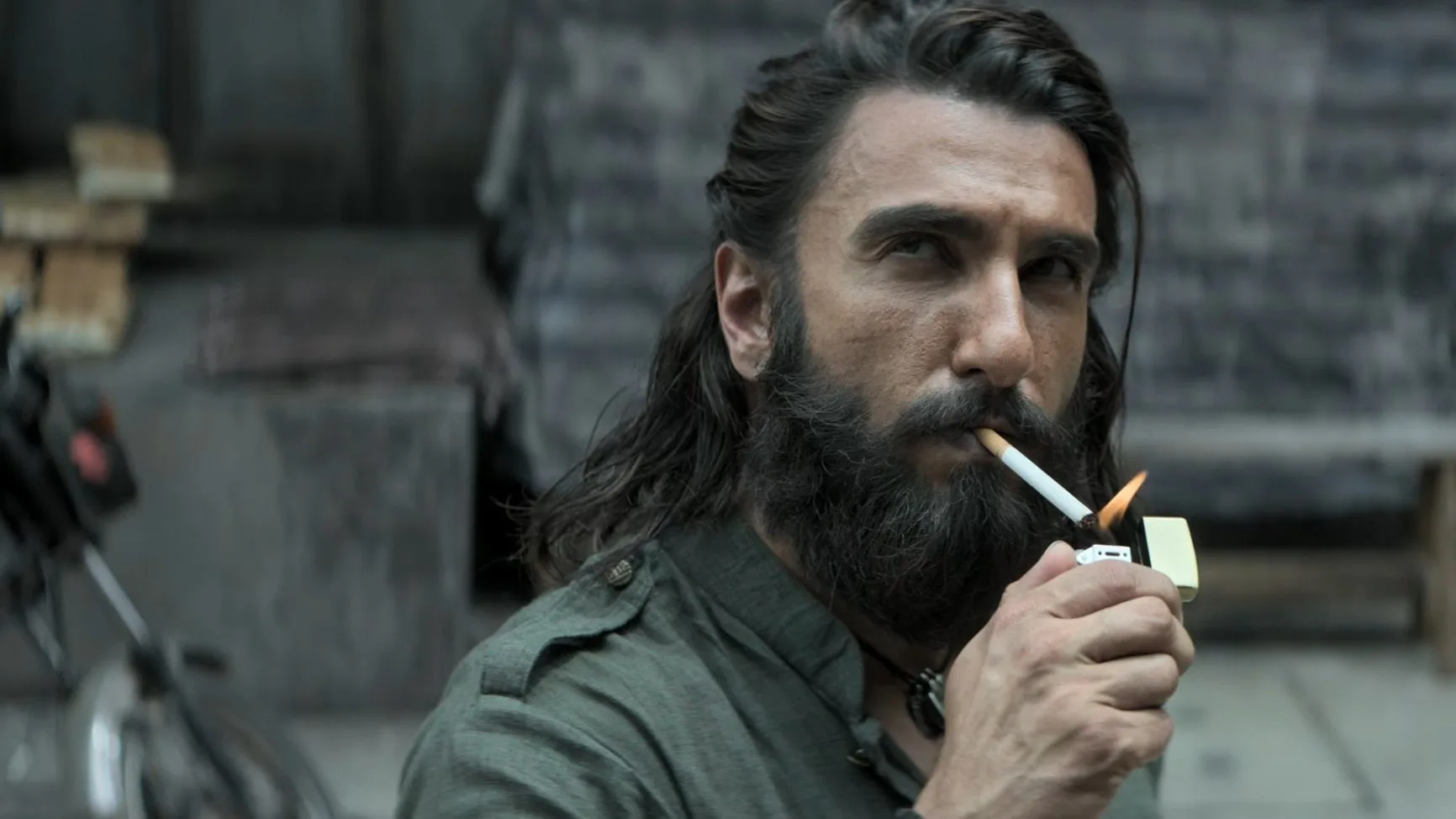
Bollywood actor Ranveer Singh has issued a public apology after facing intense backlash for mimicking a sacred scene from Rishab Shetty’s Kantara Chapter 1 during the closing ceremony of the 56th International Film Festival of India (IFFI) in Goa on November 28, 2025. The incident, which was captured on video and went viral across social media platforms, sparked controversy when the actor not only imitated the climactic Chamundi Daiva possession sequence but also referred to the revered deity as a “female ghost,” deeply offending the Tulu community and devotees across India.
The controversy erupted just days before Ranveer Singh’s upcoming film Dhurandhar is scheduled to release in theaters on December 5, 2025. What began as an apparently well-intentioned tribute to Rishab Shetty’s performance quickly spiraled into a cultural and religious controversy that has dominated social media discussions, resulted in a formal police complaint, and prompted widespread calls for boycotts of the actor’s upcoming releases.
On December 2, 2025, Ranveer took to his Instagram Stories to address the furore, posting an official statement clarifying his intentions and apologizing to anyone whose sentiments were hurt by his actions at the prestigious film festival. The apology came after two days of mounting criticism from fans, cultural activists, and members of the Tulu community who felt the actor had trivialized their sacred traditions.
Table of Contents
The Controversial IFFI Moment That Sparked Outrage
During the closing ceremony of IFFI 2025 in Goa, Ranveer Singh took to the stage in what appeared to be a spontaneous moment of appreciation for Kantara Chapter 1, which had been showcased at the festival. Rishab Shetty, the film’s director and lead actor, was seated in the audience, along with other dignitaries including legendary actor Rajinikanth.
Addressing Shetty directly from the stage, Ranveer enthusiastically recounted his theatrical experience watching the film. “I watched Kantara Chapter 1 in theatres, and Rishab, it was an outstanding performance, especially when the female ghost (Chamundi daiva) enters your body—that shot was amazing,” the actor said, his words clearly audible in the viral video that subsequently circulated online.
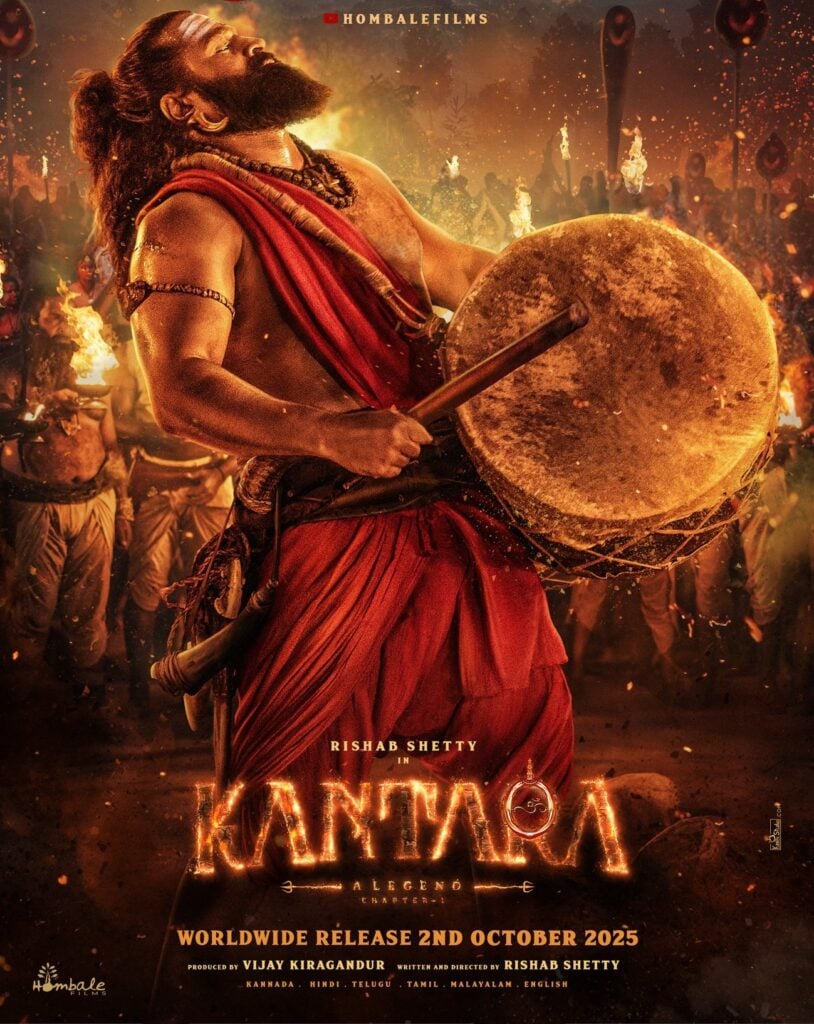
The term “female ghost” immediately raised red flags among viewers familiar with Tulu culture and Daiva worship traditions. Chamundi Daiva, also known as Chavundi, Pilichavundi, or Pilchandi, is not a ghost but a powerful guardian deity worshipped predominantly in the Tulu Nadu region of coastal Karnataka. She is a central figure in the Bhoota Kola tradition, embodying fierce feminine energy that protects communities, punishes wrongdoers, and restores balance.
After making this statement, Ranveer then proceeded to step down from the stage to personally greet the dignitaries, including Rishab Shetty. According to a Bangalore Times report, when Ranveer approached Rishab, he became excited and began mimicking the Daiva possession scene. Eyewitnesses stated that Rishab Shetty politely asked him to stop, raising a finger to signal that such portrayals should not be recreated casually, especially given their sacred nature.
However, Ranveer apparently did not fully register the gentle warning. He returned to the stage and recreated the possession sequence again, this time with more dramatic intensity, screaming and contorting his body to imitate the climactic moment from the film where Shetty’s character is possessed by Chamundi Daiva. What made matters worse in the eyes of many critics was that Ranveer performed this act while wearing shoes, which further compounded the offense for those who viewed it as desecration of a sacred ritual.
Sources at the event noted that while Ranveer’s intention appeared to be celebrating Rishab Shetty’s exceptional performance in the film, his approach was deeply inappropriate. “His intention wasn’t wrong, but referring to the Daiva as a ‘female ghost’ and performing the act while wearing shoes shocked many,” an insider told Bangalore Times. “Rishab stayed calm and chose not to escalate it at such a high-profile event.”
The fact that this occurred at IFFI, one of India’s most prestigious film festivals with international attendance and media coverage, amplified the controversy significantly. What might have been contained as a private gaffe became a very public cultural flashpoint broadcast to millions through social media.
Understanding Chamundi Daiva and Tulu Cultural Traditions
To fully grasp why Ranveer Singh’s actions sparked such intense backlash, it’s essential to understand the deep cultural and spiritual significance of Chamundi Daiva and the broader Daiva worship tradition in Tulu Nadu, the coastal region of Karnataka.
Chamundi Daiva represents a unique fusion of local tribal spirit worship with pan-Indian Hindu traditions. Long before Vedic and Puranic ideas spread to coastal Karnataka, the Tulu people worshipped Chaundi, the sister of Guliga, as one of the oldest Daivas of the land. As Hindu traditions expanded, Chaundi was linked to Chamundi, a fierce form of Devi, the Mother Goddess. In Mysore, Chamundeshwari became the royal goddess, but in Tulu Nadu, the deity retained her original roots while gaining new prestige through this spiritual merger.
The most famous form is Pilichamundi, where “Pili” means tiger in Tulu. This fusion connects the tiger spirit of Tulu Nadu with the pan-Indian goddess. Historically, Tulu Nadu’s dense forests harbored tigers that threatened people, cattle, and crops. To transform fear into protection, communities worshipped the tiger spirit, which over time merged with Chamundi. Thus, Pilichamundi is not simply Chamundi riding a tiger, but the tiger and goddess fused into one powerful entity.
Daiva worship, also called Dhaivaradhane or Bhoota Kola, is a living spiritual tradition where guardian spirits are honored through elaborate nightlong ceremonies. These rituals involve specially trained performers called paatris, who belong to hereditary families like the Nalike or Pambada communities. From childhood, these individuals are trained in sacred dance, songs, and discipline to safely channel the spirit during possession rituals.
The term “Bhoota” derives from Sanskrit bhūta, meaning “spirit” or “being,” but in Tuluva culture, a Bhoota is not a ghost in the Western sense—it is a guardian spirit, a powerful divine being worthy of reverence. During Bhoota Kola ceremonies, the Daiva enters the human world through the paatri’s body, offering blessings, settling disputes, and providing guidance to the community.
Kantara Chapter 1 respectfully portrays this tradition by exploring the mythological origins of these sacred practices. The film is set in the fourth century during the Kadamba dynasty and follows Berme, the protector of the Kantara forest and its tribal communities, as he navigates conflicts between royal power and spiritual traditions. The climactic possession sequence that Ranveer mimicked is one of the film’s most intense and spiritually significant moments, requiring months of preparation by Rishab Shetty to perform authentically and respectfully.
The makers of Kantara Chapter 1 have been extremely careful to emphasize the sacred nature of these portrayals. Earlier in 2025, when fans began dressing up as Daiva characters and entering theaters, the production team issued an official statement urging people to refrain from such imitations. “Dhaivaradhane or Daiva worship, as featured in the film, is rooted in deep spiritual tradition and is not intended for performance or casual mimicry,” the statement read. “Such acts amount to trivialising our belief system and deeply hurt the religious sentiments and faith of the Tulu community.“
Rishab Shetty himself has emphasized this point in interviews, stating, “We do it for the cinematic experience and for the story’s emotional arc. But the concept of Daiva that we have brought into the film, that is not cinema for us.” This statement underscores that even the film’s creators view these portrayals as requiring utmost respect and careful handling, not as material for casual entertainment or mimicry.
The Social Media Backlash and Police Complaint
Within hours of the video from IFFI going viral, social media platforms erupted with criticism of Ranveer Singh’s actions. Twitter (now X), Instagram, Facebook, and other platforms were flooded with posts from angry users who felt the actor had disrespected their culture and faith.
One user on X wrote: “Dear @RanveerOfficial you don’t know the difference between God and Ghost …. Chavundi is Goddess not ghost .. And you literally mocking on big stage.” The post captured the essence of many people’s frustration—not just with the mimicry itself, but with the fundamental mischaracterization of a revered deity as a “ghost.”
Another user commented more bluntly: “#RanveerSingh literally called chavundi mata a ghost and mimicked her in funny way Isn’t this Blasphemy.” The use of the term “blasphemy” indicated how seriously many viewers took the offense, viewing it not merely as cultural insensitivity but as a religious violation.
Karnataka-based users were particularly vocal in expressing their hurt. “As someone from Karnataka, it’s hurtful to see our deities being called ‘ghosts’. It’s not just a performance for us; it’s faith. Thank you, Rishab Shetty, for standing up for our culture right there. Jai Bhootaraya!” wrote one commenter, praising Shetty for attempting to stop Ranveer on stage.
The backlash wasn’t limited to individual social media users. The Hindu Janajagruti Samiti (HJS), a Hindu organization known for advocating on religious and cultural issues, filed an official complaint against Ranveer Singh at the Panaji police station in Goa. The complaint alleged that the actor had “insulted Goddess Chamundadevi by describing the deity in a derogatory manner” and engaged in actions that hurt religious sentiments.
In their complaint, HJS representatives stated that Chamundi Daiva is considered a sacred family deity of the Tulu community, and depicting the deity disrespectfully can cause unrest and hurt religious sentiments. They demanded a public apology from the actor and appropriate action to ensure such incidents don’t recur at prestigious cultural events.
The timing of the controversy proved particularly problematic for Ranveer Singh’s upcoming film Dhurandhar. Advance bookings for the spy-action thriller, which began on December 2, 2025, reportedly opened to a weak start. Many social media users explicitly connected the poor advance sales to the Kantara controversy, with some calling for boycotts of the film.
“Boycott the upcoming Ranveer Singh movie Dhurandhar. He should not make fun of the Goddess and Daivasa,” wrote one user, while another added, “We DON’T want to see Ranveer in the next Kantara movie,” referencing an off-hand comment Ranveer had made during his IFFI appearance about potentially appearing in a future Kantara installment.
Comments flooded Ranveer’s recent Instagram posts promoting Dhurandhar, with users expressing disappointment and anger. “Super Flop h bhai,” wrote one commenter, while another stated, “I request all ppl….. please don’t watch his movie.” Still another wrote pointedly, “Kantara is way out of your league,” suggesting that Ranveer lacked the cultural understanding and sensitivity to engage with such material.
Some users questioned whether the apology was genuine or merely damage control prompted by commercial concerns. “Many felt the apology came only because of the low advance bookings of Dhurandhar,” noted one report analyzing the social media response. This skepticism about the timing and sincerity of the apology complicated Ranveer’s attempts to move past the controversy.
| Date | Event |
|---|---|
| November 28, 2025 | Ranveer Singh mimics Daiva possession scene and calls Chamundi “female ghost” at IFFI closing ceremony |
| November 29, 2025 | Video goes viral on social media; backlash begins mounting |
| November 30, 2025 | Hindu Janajagruti Samiti files police complaint in Panaji |
| December 2, 2025 | Ranveer Singh issues apology on Instagram; Dhurandhar advance bookings begin with weak numbers |
| December 5, 2025 | Dhurandhar scheduled for theatrical release |
Ranveer Singh’s Public Apology and Clarification
On the morning of December 2, 2025, Ranveer Singh addressed the controversy through an official statement posted to his Instagram Stories. The carefully worded apology attempted to clarify his intentions while acknowledging the hurt his actions had caused.
“My intention was to highlight Rishab’s incredible performance in the film,” Ranveer wrote. “Actor to actor, I know how much it would take to perform that particular scene in the way that he did, for which he has my utmost admiration.”
This opening emphasized that Ranveer’s actions stemmed from professional respect and appreciation for a fellow actor’s work. By framing it as an “actor to actor” acknowledgment, he attempted to convey that his mimicry was meant as the highest form of praise—acknowledging the difficulty and skill required to perform such an intense scene.
The statement continued: “I have always deeply respected every culture, tradition and belief in our country. If I’ve hurt anyone’s sentiments, I sincerely apologise.”
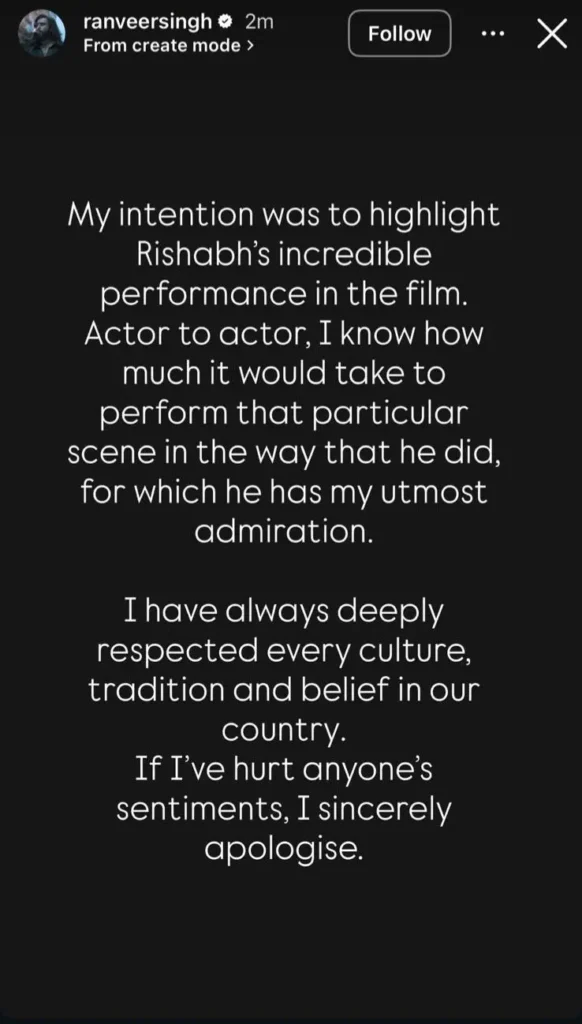
The conditional phrasing “if I’ve hurt” drew some criticism from observers who felt it hedged on full accountability. However, the inclusion of “sincerely” and the statement’s overall tone suggested genuine contrition rather than a pro forma celebrity apology.
Ranveer’s statement notably avoided explicitly acknowledging his specific errors—calling Chamundi Daiva a “female ghost” and performing the mimicry despite Rishab Shetty’s warning. Some commentators felt a more effective apology would have directly addressed these missteps: “I should not have referred to Chamundi Daiva as a ‘ghost,’ as she is a revered deity,” or “I should have heeded Rishab’s signal to stop rather than continuing the mimicry.“
Nevertheless, the apology represented an attempt to de-escalate the situation and acknowledge the seriousness with which the Tulu community and broader Hindu public viewed the incident. The fact that Ranveer issued the statement relatively quickly—within two days of the incident—suggested that his team recognized the severity of the backlash and moved to contain the damage.
The apology’s reception on social media was decidedly mixed. Some users accepted it as a genuine acknowledgment of error. “The apology is appreciated. We all make mistakes. What’s important is he acknowledged it and showed respect for the culture. Let’s not cancel people for genuine errors,” wrote one commenter who urged moving forward constructively.
Others viewed it more critically, seeing the apology as insufficient or motivated primarily by commercial concerns about Dhurandhar’s prospects. “Typical Bollywood disconnect from regional cultures. Rishab Shetty was right there trying to stop him! That should have been the biggest clue. Glad he apologized, but the damage is done. Hope others learn from this,” one user wrote, suggesting the apology couldn’t undo the cultural insensitivity displayed.
Still others framed the incident as educational rather than simply condemnable. “This is why representation matters. If more people understood Tulu culture and Daiva traditions, such mistakes wouldn’t happen. Kantara was a masterpiece that educated many. Ranveer’s act, while wrong, has sparked a needed conversation,” observed one thoughtful commenter, acknowledging the silver lining of increased awareness about regional cultural traditions.
Rishab Shetty’s Measured Response
As of December 3, 2025, Rishab Shetty has not issued any official public statement regarding the controversy. His silence has been interpreted in various ways by observers and commentators.
Some view it as strategic restraint, avoiding further fueling a controversy that has already generated significant negative attention. By not commenting, Rishab allows the focus to remain on the broader cultural issues rather than personalizing it as a conflict between two actors. This approach also prevents him from appearing vindictive or ungracious toward a colleague who was ostensibly trying to praise his work.
Others see his silence as a continuation of the composure he displayed at IFFI itself. According to multiple eyewitness accounts, when Ranveer approached him during the ceremony and began mimicking the Daiva possession, Rishab politely signaled for him to stop rather than creating a scene. When Ranveer continued anyway, Rishab remained calm and chose not to escalate the situation at such a high-profile international event.
This measured response aligns with Rishab Shetty’s public persona as someone deeply committed to respectfully representing Tulu culture and traditions. Throughout the promotion and release of both Kantara films, he has consistently emphasized the sacred nature of Daiva worship and the responsibility that comes with bringing these traditions to cinematic life.
In previous interviews, Rishab has spoken about the extensive preparation required for the Daiva possession sequences. He underwent months of training with actual Daiva performers, studied the rituals intensely, and worked closely with cultural consultants to ensure authenticity and respect. The commitment he demonstrated stands in stark contrast to Ranveer’s spontaneous, casual mimicry.
The fact that Rishab and his team had previously issued statements specifically asking fans not to imitate Daiva characters from the film makes Ranveer’s actions at IFFI even more problematic. The production had already anticipated and tried to prevent exactly this kind of casual recreation of sacred rituals, recognizing how such acts could trivialize the faith traditions of the Tulu community.
According to the Bangalore Times source, during their brief interaction at IFFI, Ranveer and Rishab shared what appeared to be a “friendly rapport,” suggesting there may not be personal animosity between the two actors. This cordiality, despite the culturally inappropriate actions, may explain why Rishab has chosen not to publicly call out Ranveer beyond the gentle warning he gave in the moment.
The Kantara Chapter 1 team’s previous statements about respecting Daiva traditions effectively serve as the official position without requiring Rishab to personally attack or criticize Ranveer. The production company’s clear guidelines about not imitating these sacred characters speak for themselves and provide context for why Ranveer’s actions were inappropriate, regardless of his intentions.
Impact on Dhurandhar and Ranveer’s Career
The controversy has cast an unfortunate shadow over what should have been an exciting promotional period for Dhurandhar, Ranveer Singh’s upcoming spy-action thriller. Directed by Aditya Dhar and produced under Jio Studios and B62 Studios, the film features an impressive ensemble cast including Sanjay Dutt, Akshaye Khanna, R. Madhavan, and Arjun Rampal, with Sara Arjun and Rakesh Bedi in supporting roles.
The film’s advance bookings, which began on December 2, 2025—the same day Ranveer issued his apology—reportedly opened with disappointing numbers. While it’s impossible to attribute this entirely to the Kantara controversy, the timing is certainly inauspicious. Social media sentiment analysis shows a significant volume of negative comments specifically connecting the boycott calls to ticket purchasing decisions.
Dhurandhar has also faced additional controversies beyond the Kantara incident. The parents of the late Major Mohit Sharma have moved the Delhi High Court seeking to stay the film’s release, believing it to be a fictionalized portrayal of their son’s activities done without proper consent. This legal challenge has created uncertainty about whether the film will release as scheduled on December 5, 2025.
Additionally, the film recently received an “A” (Adults Only) certificate from the Central Board of Film Certification (CBFC), with violent scenes reportedly cut from the final version. While this doesn’t necessarily doom the film commercially—many action films have succeeded with A certificates—it does limit the potential audience by excluding viewers under 18.
The combination of the Kantara controversy, the legal challenge from Major Sharma’s family, the A certificate, and generally weak advance bookings has created a perfect storm of negative factors that could significantly impact Dhurandhar’s commercial prospects. Industry analysts are watching closely to see whether the film can overcome these obstacles through positive word-of-mouth once released, or whether the pre-release controversies will prove insurmountable.
For Ranveer Singh personally, the incident adds to a growing perception in some quarters that mainstream Bollywood actors lack proper cultural sensitivity when engaging with regional traditions and subject matter. This controversy follows similar incidents where major Bollywood figures have been criticized for appropriating or misrepresenting regional cultural elements without proper understanding or respect.
However, Ranveer’s generally strong box office track record and loyal fan base may help him weather this storm. His previous films have demonstrated his ability to connect with audiences across India, and his energetic, enthusiastic persona usually works in his favor. If he can demonstrate through actions that he has genuinely learned from this incident and shows greater cultural sensitivity going forward, the long-term damage to his career may be limited.
The incident also highlights the evolving dynamics of pan-India cinema, where actors increasingly work across linguistic and cultural boundaries. As regional films gain national and international prominence—as Kantara itself did—the need for cultural competence and sensitivity becomes more critical for all industry professionals, regardless of which language or region they primarily work in.
Broader Implications for Cultural Representation in Cinema
The Ranveer Singh-Kantara controversy raises important questions about cultural representation, respect for religious traditions, and the responsibilities of public figures when engaging with sensitive material. These issues extend far beyond this single incident to broader patterns in how mainstream Indian cinema engages with regional cultures and spiritual traditions.
One key issue is the knowledge gap that often exists between urban, cosmopolitan film industries like Bollywood and the diverse regional cultures across India. Many Bollywood professionals may have limited exposure to traditions like Daiva worship, making them prone to unintentional insensitivity when encountering these practices. The fact that Ranveer referred to Chamundi Daiva as a “female ghost” suggests a fundamental misunderstanding rooted in applying Western horror movie concepts to indigenous spiritual traditions.
This knowledge gap is particularly problematic in an era when films like Kantara, Baahubali, KGF, Pushpa, and RRR have demonstrated that regional stories with strong cultural rootedness can achieve massive pan-India and even international success. As these films educate audiences about traditions they may not have known about, they also create opportunities for misrepresentation or appropriation by those who don’t fully understand the cultural context.
The incident also highlights tensions between artistic appreciation and cultural appropriation. Ranveer clearly intended his mimicry as a form of tribute—recognizing and celebrating Rishab Shetty’s exceptional performance. In many contexts, imitation is considered the highest form of flattery, with actors frequently mimicking each other’s iconic scenes and dialogues as expressions of admiration and respect.
However, this standard doesn’t apply when the material being imitated is sacred religious content. There’s a fundamental difference between mimicking a clever dialogue delivery or action sequence and recreating a divine possession ritual that holds deep spiritual significance for living communities. Ranveer’s error was failing to recognize this distinction, treating the Daiva possession as just another impressive acting performance rather than as a respectful cinematic representation of sacred practices.
The controversy also raises questions about the role of film festivals and cultural events in maintaining appropriate boundaries. IFFI is a prestigious international platform where cinema from around the world is celebrated. Should festival organizers have anticipated that spontaneous performances by attendees might cross cultural or religious lines? What protocols might prevent such incidents without stifling the enthusiasm and informal interactions that make such events vibrant?
Some commentators have noted that the presence of shoes—which are generally removed during Hindu religious ceremonies—compounded the offense in Ranveer’s mimicry. This detail highlights how multiple layers of cultural understanding are necessary when engaging with religious material. It’s not enough to know that something is sacred; one must also understand the specific protocols and taboos surrounding its representation and enactment.
The incident has sparked broader conversations on social media about the need for cultural education and sensitivity training for actors working across India’s diverse regions. As pan-India cinema continues to grow, ensuring that creators and performers understand the cultural contexts they’re engaging with becomes increasingly important. Some have suggested that film schools and production companies should provide cultural competency training to help avoid incidents like this.
On a positive note, the controversy has educated millions of people about Tulu culture, Daiva worship traditions, and the sacred nature of practices featured in Kantara. Many users acknowledged in their comments that they had learned about these traditions through the films themselves and now understood them better through the discussions sparked by Ranveer’s gaffe. In this sense, the incident has served an educational function, even if through a negative example.
The film industry’s response to this controversy will be telling. Will production companies, festival organizers, and industry associations take steps to prevent similar incidents? Will mainstream actors become more thoughtful about how they engage with regional cultural material? Or will this be viewed as an isolated incident that generated temporary outrage before being forgotten?
FAQs
What did Ranveer Singh do at IFFI that caused controversy?
At the IFFI 2025 closing ceremony, Ranveer mimicked the climactic Chamundi Daiva possession scene from Kantara Chapter 1 and called the deity a “female ghost.” Rishab Shetty, who was in the audience, signaled him to stop, but Ranveer continued the mimicry on stage.
Why was calling Chamundi Daiva a “ghost” offensive?
Chamundi Daiva is a revered guardian deity in Tulu culture, not a ghost. The Daiva tradition is a sacred spiritual practice in coastal Karnataka where divine spirits are worshipped through elaborate rituals. Referring to the deity as a “ghost” fundamentally mischaracterizes the sacred nature of this cultural practice.
What was Ranveer Singh’s apology?
Ranveer issued an apology on Instagram stating his intention was to highlight Rishab’s performance and that he has “always deeply respected every culture, tradition and belief” in India. He sincerely apologized to anyone whose sentiments were hurt by his actions.
What is Kantara Chapter 1 about?
Kantara Chapter 1 is a period action thriller set in fourth-century Karnataka during the Kadamba dynasty. It explores the mythological origins of Panjurli Daiva and Guliga Daiva, following Berme, the protector of the Kantara forest, as he navigates conflicts between royal power and tribal spiritual traditions.
How has the controversy affected Ranveer Singh’s film Dhurandhar?
The controversy came just before Dhurandhar’s December 5, 2025 release. Advance bookings reportedly opened with weak numbers, with social media users calling for boycotts. The film also faces a legal challenge from late Major Mohit Sharma’s family and received an A certificate from CBFC.