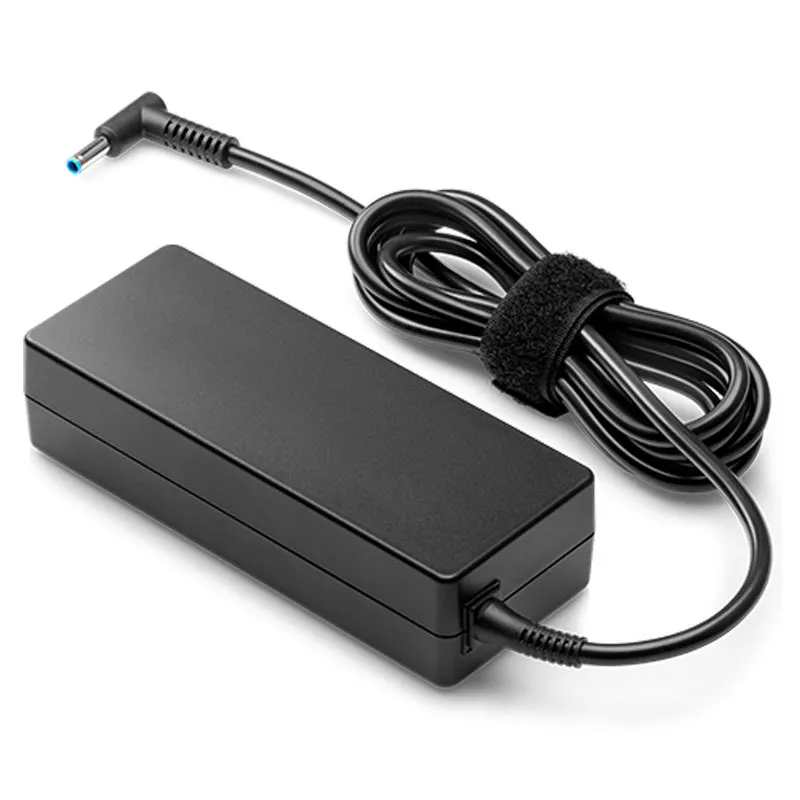
Ever tripped over that clunky black box dangling halfway down your charger cable and wondered, “Why can’t they just make this thing disappear?” You’re not alone. That brick has a name — a power adapter, or more technically, an AC-to-DC converter — and it’s doing more work than you’d ever guess for something so unglamorous.
Let’s break down why it exists, why it gets hot, and whether laptop charging is finally getting smaller.
Table of Contents
The Real Job of That Black Brick
Your wall socket delivers Alternating Current (AC) — electricity that switches direction rapidly. But your laptop’s battery runs on Direct Current (DC), a steady one-way flow. The brick’s entire job is to convert AC into clean, stable DC power your laptop can actually use.
Inside that seemingly simple box is a surprisingly complex assembly:
| Component | Function |
|---|---|
| Transformer | Steps voltage up or down to the level your laptop needs |
| Rectifier | Converts AC into rough DC |
| Capacitors | Smooth out electrical ripples for stable output |
| Voltage Regulator | Keeps output steady even if input fluctuates |
| Casing | Insulates and dissipates heat safely |
All of that hardware needs physical space — which is exactly why the brick can’t just vanish into the cable.
Why Size Still Matters (For Now)
Laptops need far more power than phones — often between 45W and 240W, compared to a phone’s 5W-20W. More power means more heat, and heat needs room to escape. Cram too many components into too small a shell, and you risk overheating, reduced lifespan, or in worst-case scenarios, safety hazards.
That’s also why gaming laptops — which often demand 200W or more — tend to have some of the largest, heaviest bricks on the market.
The Shift Toward Smaller Chargers: GaN Technology
Here’s the good news: bricks are shrinking, thanks to Gallium Nitride (GaN) semiconductors replacing traditional silicon. GaN chips handle higher voltages more efficiently and generate less heat, which means manufacturers can shrink the internal components significantly.
According to the U.S. Department of Energy, wide-bandgap semiconductors like GaN can operate at higher temperatures and frequencies than silicon, enabling smaller, lighter power electronics.
That’s why newer 65W-100W GaN chargers today are roughly a third the size of older laptop bricks — while charging just as fast, or faster.
USB-C: The Other Reason Chargers Are Getting Slimmer
The rise of USB-C Power Delivery (USB-PD) has also changed the game. Instead of proprietary barrel connectors, most modern laptops now charge via USB-C, using a universal charging standard. The USB Implementers Forum notes that USB-PD supports dynamic power negotiation up to 240W, allowing a single charger type to serve phones, tablets, and laptops alike.
This standardization is part of why regulators have pushed for universal charging. The European Commission’s common charger rules require USB-C charging for most electronic devices sold in the EU, reducing e-waste and the need for multiple chargers.
Do You Actually Need the Original Brick?
Short answer: not always, but be careful. As long as a replacement charger matches your laptop’s voltage and offers sufficient wattage, third-party GaN chargers are often safe and reliable. Mismatched voltage, however, can damage your battery or, in rare cases, become a fire hazard.
Always check manufacturer specifications before swapping chargers — a step brands like Dell, HP, and Lenovo emphasize in their official support documentation.
So, Will Bricks Disappear Completely?
Not entirely — physics still applies. Power conversion generates heat, and heat needs space to dissipate. But between GaN adoption, USB-C standardisation, and increasing efficiency demands, the “brick” of tomorrow will likely look more like a slim puck than the chunky block we’ve tolerated for two decades.
For now, that black box isn’t a design flaw — it’s a small, hard-working power station making sure your laptop runs safely and efficiently.
Quick Recap
| Question | Answer |
|---|---|
| What does the brick do? | Converts AC wall power into DC power for your laptop |
| Why is it bulky? | Heat dissipation and multiple internal components |
| Why are new chargers smaller? | GaN semiconductors improve efficiency and reduce heat |
| Is USB-C making chargers universal? | Yes, via USB Power Delivery standards |
| Can I use a third-party charger? | Yes, if voltage and wattage specifications match |
Curious how power efficiency affects your gaming laptop’s performance during long sessions? Check out more tech breakdowns and gaming gear guides on TechnoSports to stay ahead of the curve.