


Australia has suffered a major blow to their Ashes campaign as veteran pace bowler Josh Hazlewood has been officially ruled out of the entire series with an Achilles injury, while captain Pat Cummins has been confirmed to return for the third Test in Adelaide. The contrasting news delivers both disappointment and relief for the hosts, who have already taken a commanding 2-0 lead over England with dominant eight-wicket victories in Perth and Brisbane.
Head coach Andrew McDonald confirmed the developments on Tuesday, December 9, revealing that Hazlewood would play no further part in the five-match series after suffering multiple injury setbacks during his rehabilitation. The 34-year-old right-arm quick will now shift his focus toward recovering in time for the ICC T20 World Cup beginning in February 2026, marking the first time since his debut in 2014 that he could potentially miss an entire Ashes series.
Table of Contents
Hazlewood’s Injury Timeline and Setbacks
Josh Hazlewood’s exclusion from the Ashes represents a cruel sequence of misfortune for one of Australia’s most reliable pace bowlers over the past decade. The injury saga began during New South Wales’ Sheffield Shield match against Victoria last month, when Hazlewood strained his hamstring while preparing for the Ashes series. Initial scans failed to detect the issue, but repeat imaging revealed a hamstring strain that sidelined him for the opening two Tests.
While rehabilitating from the hamstring problem, Hazlewood developed Achilles soreness in what McDonald described as “somewhere lower in the calf to Achilles region.” Cricket Australia initially characterized the Achilles issue as “low-grade” and expected Hazlewood to resume running and bowling activities within a week. However, the injury proved more problematic than anticipated, forcing the cancellation of his planned trip to Brisbane to rejoin the Test squad.

McDonald expressed his disappointment at Tuesday’s press conference, stating: “Unfortunately, Josh won’t be a part of the Ashes. Really, really flat for him. A couple of setbacks that we didn’t see coming, and we thought he would play a huge part in the series. It’s a totally separate injury. It’s somewhere lower in the calf to Achilles region. His preparation will then shift towards the World Cup, which is an incredibly important campaign for us.”
The dual nature of Hazlewood’s injuries—first the hamstring, then the Achilles—reflects a pattern that has plagued him in recent years. Since 2021, the tall paceman has missed chunks of cricket with side strains, calf issues, and hamstring problems. In 2023, an Achilles injury kept him out of action for four months and caused him to miss the entire India Test series. The recurring Achilles troubles have become particularly concerning given Hazlewood’s history of extended recovery periods from such injuries.
Impact on Australia’s Bowling Attack
Hazlewood’s absence removes a crucial component from Australia’s traditionally formidable pace trio. For a decade, the combination of Pat Cummins, Mitchell Starc, and Josh Hazlewood has formed one of cricket’s most lethal bowling units. Hazlewood brings remarkable consistency to the attack, with his ability to bowl tight lines and lengths creating sustained pressure that complements Starc’s aggression and Cummins’ leadership.
In Test cricket, Hazlewood has claimed 295 wickets from 76 matches at an impressive average of 24.21. His metronomic accuracy and ability to extract movement from any surface made him particularly valuable in Australian conditions, where his height generates awkward bounce that troubles even the best batsmen. His last appearance came during the three-Test series against the West Indies in July, where he captured 14 wickets before suffering the lumbar bone stress injury that has kept Cummins sidelined.
Mitchell Starc has shouldered the burden magnificently in the absence of both Cummins and Hazlewood. The left-arm quick has been the standout performer of the series thus far, claiming 18 wickets in the first two Tests and earning consecutive player-of-the-match awards. Starc’s ability to swing the ball at high pace has been devastating, but his workload becomes a concern with three Tests remaining and Hazlewood now unavailable to share the new-ball responsibilities.
McDonald confirmed that Starc had pulled up well despite experiencing some discomfort during the Gabba Test. “Starcy had a little bit of a hindrance with, I think it was his left side with a bit of a jamming injury there that probably you saw visibly on TV,” McDonald explained. “But nothing to worry about. That’s something he’s had before. It was just annoying during the game. But an incredible workload from him with both bat and ball, and he’s pulled up well, which is a real positive for us.”
Australia’s pace bowling depth will be thoroughly tested over the final three matches. Scott Boland has performed admirably as Cummins’ replacement, bringing his trademark accuracy and ability to hit the seam consistently. Michael Neser enhanced his claims with a five-wicket haul in Brisbane’s second innings, demonstrating the quality available to the selectors. With Cummins returning, the selection panel faces difficult decisions about which two bowlers among Boland, Neser, and Brendan Doggett make way.
Cummins Ready to Resume Leadership Duties
The positive news for Australia centers on Pat Cummins’ confirmed return for the Adelaide Test beginning December 17. The 32-year-old captain has been sidelined since July with a lumbar bone stress injury suffered during the Caribbean tour, missing not only the first two Ashes Tests but also the entire home summer leading into the series. Steve Smith has capably led the team in his absence, but Cummins’ return brings back Australia’s established leadership structure.
McDonald provided reassuring updates about Cummins’ readiness, emphasizing the extensive preparation work conducted away from match conditions. “His body’s ready to go and barring anything else happening in the next week, I’d be expecting Pat to be tossing the coin and putting the blazer on,” McDonald stated. The coach revealed that Cummins was extremely close to playing at the Gabba in Brisbane, with his selection creating “a real live conversation” among the selection panel.
“He was well ahead of where we thought he’d be at. And it did create a real live conversation for Brisbane, the skill readiness, the loads, how he was pulling up. It was debated a lot leading into that Test match,” McDonald explained. “So with that in mind, us seeing him further advanced, we feel he’ll be really well placed for the challenges of Adelaide, albeit off a long way off. We feel as though the simulation in the nets have got him skill ready.”
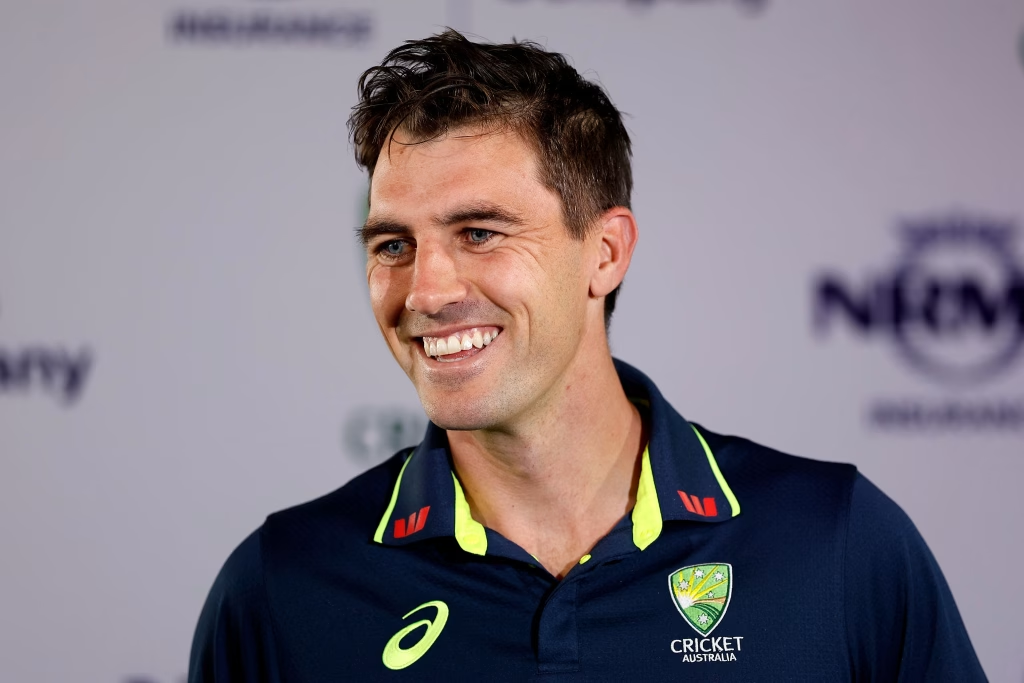
Cummins has spent recent weeks at Allan Border Field while the team competed at the Gabba, simulating match conditions through multiple bowling spells in the nets. This approach replicates Australia’s previous strategy with Cummins when managing his return from extended layoffs, focusing on rebuilding his body through carefully structured training rather than rushing him back through competitive cricket.
McDonald emphasized there would be no match opportunities for Cummins before Adelaide, but expressed confidence in his preparation: “There won’t be any match opportunities for Pat, and this is something we’ve done with Pat before, off long layoffs, where we’ve put some time and effort into rebuilding his body. He was out at Allan Border Field, while everyone was out at the Gabba. So he simulated pretty much what a match will look like out there with multiple spells. So we feel as though he’ll be as well prepared as he can be.”
The decision to hold Cummins back from Brisbane despite his advanced recovery demonstrates Australia’s cautious approach to their captain’s workload. With three Tests remaining and the series effectively secured, the medical staff prioritized ensuring Cummins returns fully fit rather than risking his availability for the remainder of the series. The pink-ball Test in Brisbane also influenced the decision, as the unique demands of day-night cricket made it a less ideal return fixture.
Selection Dilemmas for Adelaide
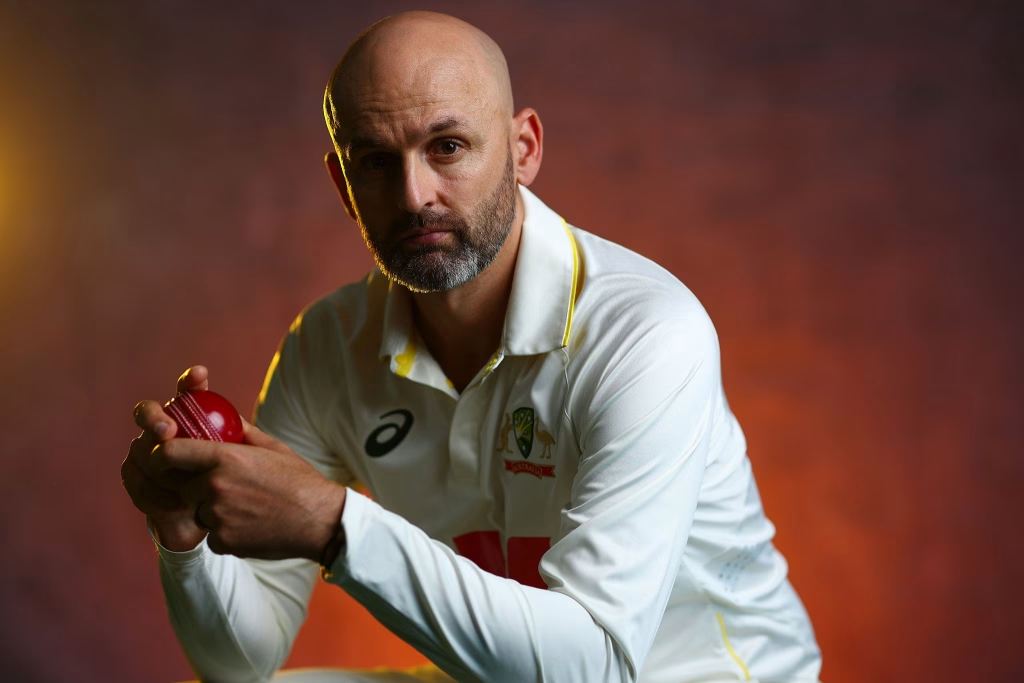
Cummins’ return creates interesting selection questions for the Adelaide Test, particularly regarding the composition of Australia’s bowling attack. With Nathan Lyon also expected to return after being omitted for Brisbane’s pink-ball conditions, two bowlers from the successful Brisbane XI will need to make way. The competition likely centers on Boland, Neser, and Doggett, with all three having performed creditably in the opening Tests.
McDonald defended Lyon’s omission from Brisbane, emphasizing it reflected pink-ball cricket requirements rather than any concerns about the veteran off-spinner’s form. “We just value different things in the pink-ball game, and unfortunately, that meant Nathan had to be squeezed,” McDonald explained. “That’s nothing to do with his skill set. Not a reflection on where he’s at from his own performance. It is a reflection on pink-ball cricket and a reflection on the surface that was presented to us.”
The coach stressed that Lyon would play a crucial role in the remaining Tests. “We still do value spin. The surfaces have pushed us in different directions, and that’s the first game that Nathan’s missed in Australia for a long time. I think Nath is going to have an incredibly huge impact in the last three Test matches.” McDonald pointed to Lyon’s performance at the MCG last year when conditions became benign, noting his ability to hold an end while rotating the three quicks represented Australia at their best.
Boland’s Test record speaks for itself—his accuracy and consistency have made him a reliable option whenever called upon. His ability to bowl unchanged spells while maintaining pressure through relentless line and length appeals to selectors seeking control. Neser, meanwhile, delivered exactly when opportunity knocked in Brisbane, his five-wicket haul demonstrating he possesses wicket-taking ability alongside control. McDonald acknowledged the difficult decision, saying Neser “would be unlucky to be omitted” after his maiden Test five-for that helped swing the game in Australia’s favor.
The likelihood is that Australia will field their first-choice attack for Adelaide, with no consideration of resting anyone despite the short four-day turnaround before the Boxing Day Test in Melbourne. “In the pre-planning, which is something we do around the Test matches and work out where the stress points potentially will be, the gap between [Test] one and two and two and three was something we think we could manage,” McDonald said. “So it would be more than likely the best balanced and available attack for Adelaide.”
Khawaja’s Return and Middle-Order Flexibility
Beyond the bowling decisions, Australia faces intriguing batting considerations with Usman Khawaja expected to be fit and available after missing Brisbane with back spasms. The left-hander’s absence opened the door for Travis Head and Jake Weatherald to form a new opening partnership, and the pair responded magnificently with 70-plus stands in both Perth and Brisbane. Their success creates a genuine selection dilemma about where Khawaja fits in the batting order.
McDonald revealed the selectors are open to batting Khawaja in the middle order rather than automatically restoring him to his traditional opening position. “The assumption is that Uzzie can only open as well,” McDonald noted. “So I think that he does have the flexibility.” This flexibility reflects cricket’s evolving approach to batting roles, with players increasingly valued for adaptability rather than rigid position assignments.
Josh Inglis, who replaced Khawaja for Brisbane, scored 23 in challenging night-session conditions before being bowled by Ben Stokes. While his innings included several edges through the cordon, he demonstrated enough to suggest he could retain his place if selectors opt for continuity. However, Khawaja’s experience and class make him difficult to omit, particularly at Adelaide where his record is strong.
Former Australian captain Aaron Finch backed the current opening combination, telling ESPN: “I just can’t see how Australia would change that top order right now with Head and Weatherald. They look like a good opening partnership together, that they’ve got the rapport which you need at the top of the order.” This sentiment captures the dilemma—change a winning formula to accommodate an established player, or maintain momentum with the new partnership while finding Khawaja a middle-order role.
England’s Mounting Challenges
While Australia sorts through positive selection headaches, England confronts mounting problems. Already trailing 2-0 and needing victory in Adelaide to keep Ashes hopes alive, they now face an Australia side strengthened by Cummins’ return. England hasn’t won an Ashes Test in Australia since the 2010-11 series, a drought spanning nearly 15 years that reflects the enormous challenge of competing Down Under.
England’s own pace bowling resources have been depleted by Mark Wood’s exclusion from the remainder of the series with a recurrent left knee injury. Wood, England’s quickest bowler and a key weapon with his ability to generate genuine pace, suffered the injury during the Perth Test and will return home for rehabilitation with ECB medical staff. His absence forces England into further bowling reshuffle at precisely the wrong time.
The tourists have taken a short break this week to rest and recover at one of Australia’s popular beach towns, attempting to regroup mentally and physically before the crucial Adelaide Test. The margin between the teams has been stark through two matches—both ending in eight-wicket defeats for England—suggesting systemic issues rather than narrow margins that could easily swing the other way.
England’s captain Ben Stokes faces enormous pressure to halt Australia’s momentum and avoid the series being effectively decided before the Boxing Day Test at the Melbourne Cricket Ground. The Adelaide Test, beginning December 17, represents England’s last realistic opportunity to mount a comeback. Failure there would leave the final two Tests in Melbourne and Sydney as mere formalities, with the Ashes retained by Australia and attention turning to salvaging pride rather than the trophy.
Looking Ahead to Adelaide and Beyond
The third Test at Adelaide Oval promises to be fascinating for multiple reasons. Cummins’ return injects fresh energy into Australia’s campaign, bringing back their established leader and a world-class bowler who can exploit Adelaide’s traditionally pace-friendly conditions. The psychological impact of his presence—both on Australia’s dressing room and England’s batsmen—shouldn’t be underestimated.
For Hazlewood, attention now turns to rehabilitation and preparation for the T20 World Cup. The tournament begins in early February 2026, giving him approximately two months to recover from the Achilles issue and rebuild his fitness for the shortest format. While disappointing to miss the Ashes, focusing on the World Cup prevents any temptation to rush back prematurely and risk further injury that could jeopardize his entire summer.
The Ashes series continues with Adelaide (December 17-21), followed by the Boxing Day Test at the MCG (December 26-30) and the New Year’s Test in Sydney (January 4-8). Australia’s dominant position suggests they’re likely to claim the urn regardless of individual results in the remaining matches. However, pride remains at stake for both sides, with England desperate to avoid a whitewash and Australia seeking to complete a comprehensive victory.
Hazlewood’s absence is undoubtedly significant—losing a bowler of his caliber and consistency would impact any team. However, Australia’s depth, their 2-0 series lead, and Cummins’ return mean they remain overwhelming favorites. The question shifts from whether Australia will retain the Ashes to whether England can salvage any victories to provide hope for their beleaguered campaign. For now, the focus turns to Adelaide, where Cummins will resume leadership and Australia will aim to extend their stranglehold on cricket’s oldest rivalry.
Read More: IPL 2026 Auction: De Kock Added to 350-Player Shortlist as Cameron Green Headlines First Set
FAQs
Why has Josh Hazlewood been ruled out of the entire Ashes series?
Josh Hazlewood suffered a hamstring strain during a Sheffield Shield match against Victoria, then developed Achilles soreness during rehabilitation. Coach Andrew McDonald confirmed these were separate, unexpected setbacks that ruled him out of the series. He will now focus on recovering for the T20 World Cup in February 2026.
When will Pat Cummins return as Australia captain?
Pat Cummins is confirmed to return for the third Ashes Test in Adelaide starting December 17, 2025. He has recovered from a lumbar bone stress injury and has been training at Allan Border Field, simulating match conditions. McDonald stated Cummins is physically ready and will be “tossing the coin and putting the blazer on” barring any issues.
How has Australia performed without Cummins and Hazlewood?
Australia has dominated the first two Tests, winning by eight wickets in both Perth and Brisbane to take a 2-0 series lead. Mitchell Starc has been outstanding with 18 wickets and consecutive player-of-the-match awards. Scott Boland, Michael Neser, and Brendan Doggett have filled in capably under Steve Smith’s leadership.
Who will make way when Cummins and Nathan Lyon return?
Two bowlers from Brisbane’s XI must be omitted. Brendan Doggett is almost certain to miss out, but Michael Neser faces an unlucky exclusion despite his five-wicket haul. McDonald indicated Australia will field their first-choice attack with Scott Boland, Cummins, Starc, and Lyon for Adelaide.
When is Josh Hazlewood expected to return from injury?
Hazlewood is targeting the T20 World Cup beginning February 2026, approximately two months away. This timeline allows complete recovery from his Achilles injury without rushing back prematurely for the Ashes.