

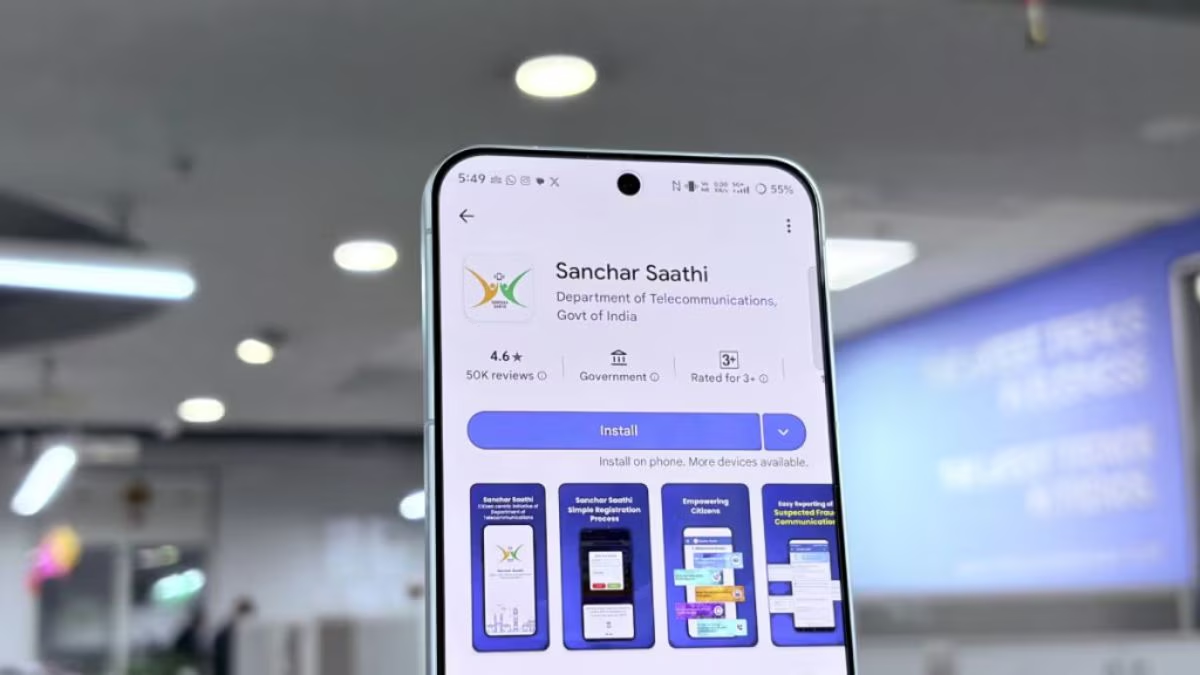
India has issued a controversial directive requiring all smartphone manufacturers to pre-install the government’s Sanchar Saathi cybersecurity app on new devices, sparking privacy concerns and potential conflicts with companies like Apple. The November 28, 2025 order gives manufacturers 90 days to comply, with the app being non-removable for users—a move authorities claim is essential to combat rising cyber fraud affecting India’s 1.2 billion smartphone users.
Table of Contents
Sanchar Saathi App Mandate Quick Facts
| Category | Details |
|---|---|
| Order Date | November 28, 2025 |
| Implementation Deadline | 90 days (approx. March 2026) |
| Affected Companies | Apple, Samsung, Xiaomi, Vivo, Oppo, all brands |
| App Name | Sanchar Saathi (“Communication Partner”) |
| User Control | Cannot be deleted or disabled |
| Scope | All new devices + existing via software update |
| Target Market | 1.2 billion smartphone users in India |
| Official Website | sancharsaathi.gov.in |
What Is the Sanchar Saathi App?
The Department of Telecom describes Sanchar Saathi as a citizen-focused initiative designed to empower mobile users, enhance their security, and raise awareness about government programs. The application helps users check connections linked to their identity documents, report stolen or lost phones, and verify device authenticity through IMEI number checking.
Since launching in January 2025, the app has accumulated over 5 million downloads and helped recover more than 700,000 lost phones, including 50,000 in October alone, while blocking over 3.7 million stolen or lost devices and terminating more than 30 million fraudulent connections.
Key features include:
- TAFCOP (Telecom Analytics for Fraud Management): Check mobile connections registered under your name
- CEIR (Central Equipment Identity Register): Report and block stolen phones across all networks
- Know Your Mobile Connections: Detect unauthorized SIM cards linked to your identity
- Verify Device Authenticity: Check if your phone’s IMEI is genuine or cloned
For more technology updates and digital safety tips, visit TechnoSports.
Why the Government Is Mandating Pre-Installation
Officials stated the app is essential to combat “serious endangerment” of telecom cyber security from duplicate or spoofed IMEI numbers, which enable scams and network misuse. IMEI (International Mobile Equipment Identity) numbers uniquely identify each device, but criminals manipulate these identifiers to facilitate fraud, operate stolen phones, and evade law enforcement tracking.
India faces a cybercrime epidemic, with millions of citizens losing money to phone-based scams annually. The government argues mandatory pre-installation ensures maximum reach, particularly among users who might not voluntarily download security apps despite being vulnerable targets.
Privacy Concerns and Global Comparisons
Technology lawyer and internet-rights advocate Mishi Choudhary stated the requirement means “the government effectively removes user consent as a meaningful choice,” with critics comparing the policy to Russia’s mandate forcing manufacturers to preload the MAX communication app.
Privacy advocates worry about:
- Data collection scope: What user information the app accesses and shares with authorities
- Lack of consent: Users cannot choose whether to install the app
- Surveillance potential: Government-mandated tracking capabilities on all devices
- Precedent setting: Other nations might follow India’s model for mandatory government apps
The mandate extends beyond new devices—manufacturers must push the app onto older models through software updates, meaning current smartphone owners will also be required to have it.
Apple’s Dilemma and Industry Pushback
Apple powers roughly 4.5% of India’s 735 million smartphones, and the company’s internal policies explicitly prohibit installing any government or third-party applications before a smartphone reaches consumers. This creates a direct conflict with the Indian directive.
Research director at Counterpoint Tarun Pathak noted Apple’s historical resistance, suggesting the company might seek a middle ground by negotiating for an option to nudge users toward installing the app rather than mandatory pre-installation.
Other manufacturers like Samsung, Xiaomi, Vivo, and Oppo—which dominate India’s Android market—face similar concerns but may have more flexibility in their operating systems to comply without violating core policies.
For insights on global technology policy and digital rights, check out TechnoSports.
How This Affects Smartphone Users in India
If you’re planning to buy a smartphone in India after March 2026, expect:
- Pre-installed Sanchar Saathi app on all new devices
- No option to uninstall the application from your phone
- Software updates pushing the app to existing phones you already own
- Potential delays in new phone launches if manufacturers resist compliance
Current smartphone owners should download the Sanchar Saathi app from the App Store or Google Play Store to familiarize themselves with its features and understand what data it accesses before it becomes mandatory.
What Happens Next: The 90-Day Timeline
Manufacturers have until approximately late February or early March 2026 to implement the directive. During this period:
- Companies will likely negotiate with the Indian government for modifications
- Privacy advocacy groups may challenge the order legally
- International pressure could mount regarding digital rights concerns
- Manufacturers might delay new product launches in India pending resolution
The outcome could reshape India’s relationship with global technology companies and establish precedents for government control over consumer devices worldwide.
FAQs
Q: Can users really not delete or disable the Sanchar Saathi app once it’s pre-installed?
Based on the government order, the app must be pre-installed in a non-removable format, meaning users cannot delete or disable it. However, the exact technical implementation remains unclear—whether it will be integrated at the operating system level or installed as a regular app with deletion permissions removed. Users might be able to limit its permissions through Android or iOS settings, though this could affect functionality. The 90-day implementation period will reveal how manufacturers balance compliance with user control, and whether any workarounds emerge for tech-savvy users.
Q: Will international travelers visiting India need the Sanchar Saathi app on their phones?
The directive specifically targets smartphones sold in India, not devices brought temporarily by international visitors. Tourists using foreign-purchased phones with international SIM cards or roaming services shouldn’t be required to install Sanchar Saathi. However, if visitors purchase local Indian SIM cards during their stay, they might be encouraged or required to download the app to activate services, as it helps verify identity and prevent fraudulent connections. The mandate focuses on securing India’s telecom infrastructure rather than surveilling all devices within its borders, so short-term visitors likely won’t face enforcement.