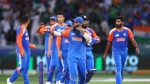
Cricket is more than a sport — it’s a billion-dollar business. And at the heart of that business is a simple question that every cricket board asks every year: how much are we getting from the ICC?
The International Cricket Council (ICC) operates on a projected annual earnings of $600 million for the 2024–2027 cycle, fuelled largely by the sale of global media rights worth over $3.2 billion — with Indian broadcaster Disney Star alone paying close to $3 billion just for rights in the Indian market.
That one number explains almost everything about what follows.
Table of Contents
ICC’s Full Breakdown: Who Gets What?
| 🏳️ Country / Member | 💰 Annual Share (USD) | 📊 % of Total |
|---|---|---|
| 🇮🇳 India (BCCI) | $231 million | ~38.5% |
| 🏴 England (ECB) | $41.33 million | 6.89% |
| 🇦🇺 Australia (CA) | $37.53 million | 6.25% |
| 🇵🇰 Pakistan (PCB) | $34.51 million | 5.75% |
| 🇿🇦 South Africa (CSA) | $26.24 million | ~4.37% |
| 🇳🇿 New Zealand (NZC) | $27.5 million | ~4.58% |
| 🌍 West Indies (CWI) | $27.12 million | ~4.52% |
| 🇱🇰 Sri Lanka (SLC) | $26.74 million | ~4.46% |
| 🇧🇩 Bangladesh (BCB) | $26.24 million | ~4.37% |
| 🇮🇪 Ireland (CI) | $18.04 million | ~3.01% |
| 🇿🇼 Zimbabwe (ZC) | $17.64 million | ~2.94% |
| 🇦🇫 Afghanistan (ACB) | $16.82 million | ~2.80% |
| 🌐 Associate Members (96 nations) | $67.16 million | ~11.19% |
Country-by-Country: What the Money Means

🇮🇳 India — $231 Million (38.5%)
India isn’t just the biggest earner — it is cricket’s economy. The BCCI drives 70–80% of ICC’s global TV revenue, and its $231 million annual share reflects that commercial dominance. Over the full 2024–2027 cycle, India stands to pocket a staggering $924 million. No other board comes close.
🏴 England — $41.33 Million (6.89%)
The ECB is cricket’s second-largest earner, yet its $41 million represents just 11% of its total annual income of ~$388 million — meaning it’s far less dependent on ICC money than smaller boards. Sky Sports’ $260 million deal for UK broadcast rights (2024–31) gives England financial muscle beyond ICC distributions.

🇦🇺 Australia — $37.53 Million (6.25%)
Cricket Australia holds the third spot, benefiting from its strong cricketing history, consistent ICC event performance, and a healthy domestic economy via the Big Bash League (BBL). CA’s net worth sits at roughly $79 million, and ICC funds supplement a robust independent revenue base.
🇵🇰 Pakistan — $34.51 Million (5.75%)
Pakistan is the only other board to cross the $30 million mark. Critically, ICC distributions form a structural pillar of PCB’s budget — roughly PKR 18.3 billion for 2025–26. This is why the Pakistan vs India fixture is so politically charged: missing one such match could cost broadcasters hundreds of crores in ad revenue alone.

🇳🇿 New Zealand — $27.5 Million (~4.58%)
NZC is notably ICC-dependent — ICC payouts represent nearly half of New Zealand Cricket’s annual revenue, a fragile position for a board with limited domestic broadcasting income. The $27.5 million is a lifeline, not a bonus.
🌍 West Indies — $27.12 Million (~4.52%)
CWI governs cricket across multiple Caribbean nations, and the $27 million must stretch across a complex multi-country operation. Despite declining Test fortunes, West Indies’ historic ICC contributions and CPL growth help maintain their allocation.

🇱🇰 Sri Lanka — $26.74 Million (~4.46%)
Sri Lanka Cricket (SLC) relies heavily on ICC funds amid ongoing financial and administrative challenges. The $26.74 million represents essential operational income for a board navigating rebuilding phases in both men’s and women’s cricket.
🇧🇩 Bangladesh — $26.24 Million (~4.37%)
Bangladesh and South Africa share near-identical distributions at ~$26 million — a remarkable parity considering their vastly different market sizes. For the BCB, ICC funds are central to sustaining growth in domestic infrastructure and player development.

🇿🇦 South Africa — $26.24 Million (~4.37%)
Despite being one of cricket’s most historically significant nations, Cricket South Africa (CSA) earns the same as Bangladesh — reflecting the ICC model’s heavy commercial weighting over history or ranking alone.
🇮🇪 Ireland — $18.04 Million (~3.01%)
Ireland, a Full Member since 2017, receives $18 million — a number that funds almost the entirety of Cricket Ireland’s operations. For a growing cricket nation, this ICC income is transformational.

🇿🇼 Zimbabwe — $17.64 Million (~2.94%)
Zimbabwe Cricket (ZC) has faced suspensions and financial crises, yet maintains a Full Member share of $17.64 million. These funds are central to keeping professional cricket alive in the country.
🇦🇫 Afghanistan — $16.82 Million (~2.80%)
The Afghanistan Cricket Board (ACB) receives the smallest Full Member allocation, yet has arguably punched above its weight on the field. The $16.82 million helps fund a cricketing programme operating under extraordinary off-field challenges.
🌐 Associate Members — $67.16 Million (~11.19%)
A combined 96 nations split just $67 million — meaning the average associate gets roughly $700,000 per year. Critics argue this leaves emerging cricket nations severely underfunded, hampering global growth of the sport.
The Bigger Picture
The ICC’s distribution formula weighs four key pillars: cricket history, ICC event performance (last 16 years), commercial contribution, and equal Full Member weightage. India’s commercial dominance essentially overrides the other three for every other nation.
India earns more than the next six boards combined. That’s not criticism — it’s the market at work. But it does raise real questions about whether the current model serves cricket’s long-term global growth.
Follow comprehensive cricket match predictions and tournament insights at TechnoSports.
FAQs
Q: What is the basis of ICC’s revenue distribution model?
The ICC uses four components — cricket history, ICC event performance, commercial contribution, and equal Full Member status — with commercial revenue (dominated by India) carrying the heaviest weight.
Q: How much do Associate Members get from ICC’s $600 million pool?
All 96 Associate Members collectively share just $67.16 million (~11.19%), meaning the average associate nation receives under $1 million per year from the ICC.