Shubman Gill Combines High Strike Rate in T20 cricket which built on a simple contest: batters attempt to maximise every delivery while bowlers try to deny them that freedom. With the value of each ball magnified in the shortest format, batters are compelled to attack far more frequently than in longer formats. That attacking intent inevitably reduces control. Playing an aggressive stroke requires earlier movement, precise positioning and sharper decision-making than a defensive one, which naturally increases the probability of false shots.
For that reason, strike rate and control percentage typically share an inverse relationship in T20 cricket. The harder a batter pushes the scoring rate, the more risk enters the equation. Yet one player has consistently resisted that pattern in the IPL. Shubman Gill is not just an outlier. He may be the most efficient batter the format has produced.
Table of Contents
The Numbers That Set Him Apart
No batter has scored as many runs in the IPL as Gill — 2,449 runs — since the start of the previous cycle in 2022. That alone is a significant achievement. But the number that truly separates him from every other elite batter in the competition is his false-shot percentage: 9.6%. Among the 69 batters with 500-plus runs in that period, he is the only one with a single-digit figure.
To appreciate the rarity of that balance, consider what it means in practice. A false shot is any delivery that induces a mistimed or poorly-controlled response — an edge, a miscue, a bottom-edge, anything that deviates from the batter’s intended execution. In a format where one in five deliveries typically produces a false shot at some batting positions, Gill producing one in roughly ten is a statistical anomaly.
Lowest False-Shot Percentage in IPL Since 2022 (500+ runs)
| Player | Innings | Runs | SR | Average | False Shot % |
|---|---|---|---|---|---|
| Shubman Gill | 59 | 2448 | 149.90 | 48.00 | 9.6 |
| Tristan Stubbs | 30 | 705 | 163.19 | 47.00 | 10.9 |
| Sanju Samson | 55 | 1636 | 149.13 | 35.56 | 12.9 |
| Ruturaj Gaikwad | 48 | 1663 | 140.33 | 38.67 | 13.1 |
| Hardik Pandya | 55 | 1273 | 139.58 | 31.04 | 13.3 |
| Dhruv Jurel | 35 | 680 | 153.84 | 30.90 | 14.0 |
| KL Rahul | 50 | 1949 | 135.44 | 46.40 | 14.1 |
| Aiden Markram | 49 | 1294 | 136.64 | 31.56 | 14.2 |
| Heinrich Klaasen | 39 | 1414 | 173.49 | 45.61 | 14.3 |
| Faf du Plessis | 54 | 1838 | 144.04 | 36.03 | 14.7 |
The gap between Gill and the next name on that list is not marginal. Tristan Stubbs, a specialist finisher who largely operates in the death overs against tired bowling, sits more than a percentage point behind. Sanju Samson, one of the most technically gifted batters in the format, is nearly three percentage points adrift. The further down the table you go, the more intuitive the numbers feel. Gill’s position at the top does not.
The broader picture is even more striking. Plotting false-shot percentage against strike rate for batters with 500-plus IPL runs since 2022 reveals a clear clustering pattern. Most high strike-rate batters sit in the upper-right region — high risk accompanying high reward. Sunil Narine, at the other extreme, thrives on volatility with a false-shot percentage of 31.3 and a strike rate of 172. Gill sits isolated toward the far left, the only player with a sub-10 figure. Near him in that neighbourhood sit Samson, Stubbs, Klaasen and Jurel — capable of combining fluency with control — yet none approach his level of consistency in minimising errors.
The Innings That Defined the Method
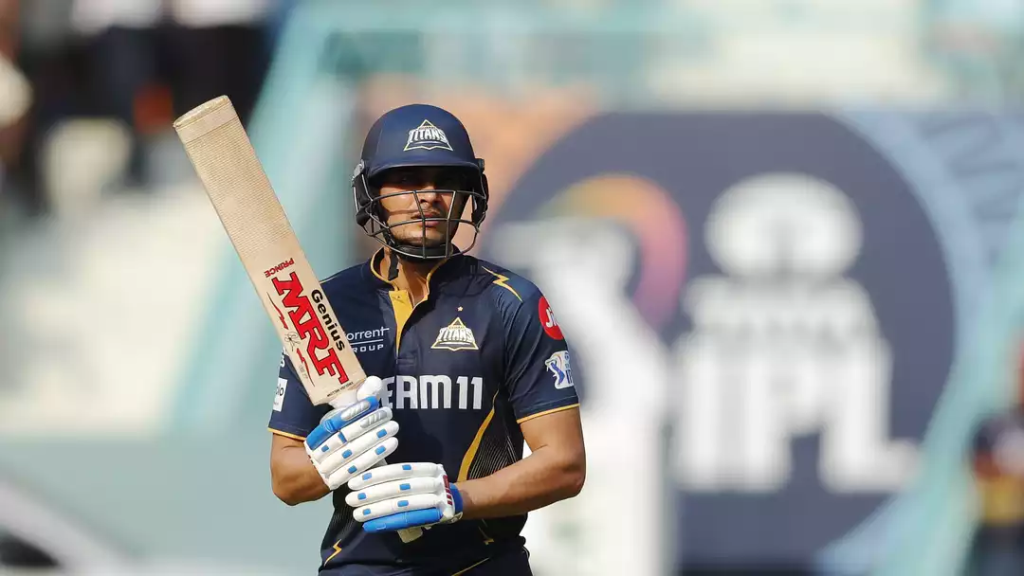
Gill’s control is not just consistent. At times it borders on immaculate. Across the entire history of the IPL, there have been only eight innings where a batter scored 50-plus without playing a single false shot. Gill owns two of them.
The first came during the 2020 season in Abu Dhabi. Playing for KKR against SRH, he struck an unbeaten 70 — the highest score in IPL history without a false shot, and the longest such stay, having faced 62 balls without a single mistimed hit. He was 21 years old, in just his third IPL season. The blueprint was already fully formed.
He replicated the feat five years later in Hyderabad. Gujarat Titans had lost two wickets inside the first four overs — a rare early stumble in their structure — but Gill absorbed the pressure to finish unbeaten on 61. It remains the only 50-plus score in all of IPL 2025 in which the batter did not play a false shot throughout the entire innings. Two different seasons, two different contexts, the same extraordinary outcome.
Why Opening Is the Hardest Job in T20
Part of what amplifies Gill’s achievement is context. Since 2022, he has opened the batting in all 60 IPL matches he has played. Opening is, statistically, the most demanding position from which to start a T20 innings — more so than lower-middle order roles, despite what the surface-level run-scoring might suggest.
The new ball offers the most lateral movement. Fielding restrictions encourage bowlers to bowl full and straight, generating the awkward lengths most likely to induce false responses. Batters are not yet set, have not read the surface, and must make high-pressure decisions in the first few deliveries before their eyes adjust.
The data reinforces this difficulty starkly.
False-Shot Percentage by Batting Position in IPL Since 2022 (First 10 balls)
| Position | False Shot % |
|---|---|
| 5 | 18.2 |
| 6 | 18.7 |
| 4 | 18.9 |
| 3 | 20.6 |
| 7 | 21.8 |
| Openers | 24.0 |
In the IPL since 2022, the false-shot percentage in the first over stands at 26.4% — the second highest of any over in an innings, marginally behind only the 20th over (26.5%), when batters attack indiscriminately in search of late boundaries. The error rate remains above 20% through the first four overs before tapering off as the ball softens and the contest begins to tilt back toward the batter.
In other words, roughly one in every four deliveries faced by an opener at the start of an innings results in a false shot. Among the 21 players who have opened at least 20 times across the last four IPL seasons, the average false-shot percentage in the first ten balls is 24%.
Gill’s figure in that same window is 12.8% — almost exactly half the average. KL Rahul, the next best on the list, registers 17.3%. That gap, between Gill and the second-best opener in the competition on this metric, is wider than the gap between Rahul and most ordinary batters.
Control Does Not Decay With Time
One of the more fascinating dimensions of Gill’s method is what happens to his error rate as his innings develops. For most batters, including the best ones, the relationship between time at the crease and control follows a recognisable pattern. The first ten balls are the most error-prone. The next ten show improvement as the batter settles. Between balls 21 and 40, false shots stabilise at under 15% as comfort increases. Beyond 40 balls, the rate climbs again as batters shift gears and begin swinging for boundaries.
Gill’s trajectory deviates from that curve almost entirely. After navigating the first ten balls, his false-shot percentage falls into single digits and remains between 6.7% and 8.6% across subsequent ten-ball phases. And crucially, this sustained control does not come at the expense of scoring rate. In each of these phases, Gill maintains a strike rate superior to the average IPL opener. He gets better, more controlled and more efficient simultaneously as his innings progresses — a combination that simply does not show up in the data for any other player in the competition.
Control Without Compromising Attack
Another dimension of his game lies in the quality of control he maintains even when attacking. In longer formats, maximising control is the central objective because wicket preservation outweighs run rate. In T20 cricket, the challenge is more nuanced — batters must attack frequently but still retain as much control as possible while doing so.
When playing attacking shots, Gill’s false-shot percentage is just 10.1%. In practical terms, he remains in control nine out of every ten attacking strokes he attempts.
False-Shot % When Attacking (IPL Since 2022, 500+ runs)
| Player | Attacking Shot % | SR (Attack) | False Shot % |
|---|---|---|---|
| Shubman Gill | 61.1 | 193.08 | 10.1 |
| Tristan Stubbs | 68.7 | 200.66 | 12.8 |
| Faf du Plessis | 65.3 | 183.21 | 14.0 |
| Hardik Pandya | 70.3 | 166.81 | 14.1 |
| Ruturaj Gaikwad | 57.7 | 187.17 | 14.2 |
| Axar Patel | 69.5 | 176.63 | 15.5 |
| Aiden Markram | 71.5 | 162.75 | 15.7 |
| Sanju Samson | 64.4 | 193.61 | 16.0 |
| Heinrich Klaasen | 74.4 | 202.25 | 16.2 |
| KL Rahul | 62.7 | 169.28 | 16.3 |
Among this group, Gill also possesses the tenth-highest balls-per-dismissal ratio when attacking (22.9). Only two players ahead of him combine a higher strike rate with better durability — Tristan Stubbs and Shashank Singh — and both operate predominantly in the death overs, a position that carries its own set of freedoms unavailable to an opener. Gill negotiates the new ball, anchors the middle overs, and often accelerates toward the finish, all while maintaining an unusually low error rate across each phase.
What It All Means for IPL 2026
Only three players feature among the top ten in both longevity at the crease and control percentage during this period: Gill, KL Rahul, and Tristan Stubbs. Gill’s presence there, while also maintaining a strike rate close to 150, underlines how unusual his method is.
Now 26, Gill stands at the peak of his powers in Tests and ODIs. Yet in T20 Internationals he currently sits outside India’s immediate plans — a curious position for a player who has quietly assembled one of the most consistent IPL records in recent seasons. The 2026 IPL therefore carries an additional layer of intrigue. Gill has already demonstrated that he can accumulate runs at scale in the format. The next phase of his evolution may be about reinforcing that his brand of efficiency — high output with minimal risk — can stand alongside the explosive styles that dominate modern T20 cricket.
Those styles are celebrated, widely broadcast, and easy to understand. What Gill does is harder to see and harder still to replicate. But the numbers do not lie. Since 2022, nobody in the IPL has done it better.
FAQs
1. What is Shubman Gill’s false-shot percentage in the IPL since 2022?
Gill’s false-shot percentage since 2022 is 9.6% — the lowest of any batter with 500-plus runs in that period. He is the only player with a single-digit figure among the 69 qualifying batters.
2. How many IPL runs has Shubman Gill scored since 2022?
Gill has scored 2,448 runs since the start of the 2022 IPL cycle — more than any other batter in the competition during that period — at an average of 48 and a strike rate of 149.90.
3. What makes Gill’s record-breaking innings from IPL 2020 significant?
Gill’s unbeaten 70 for KKR against SRH in Abu Dhabi in 2020 remains the highest score in IPL history without a single false shot. He faced 62 balls and never produced a mistimed or poorly-controlled stroke throughout the entire innings.
4. Why is opening the batting in T20 cricket considered statistically the most difficult position? Openers face the new ball with its lateral movement, fuller lengths from bowlers exploiting fielding restrictions, and unfamiliar surfaces. The data shows that openers’ false-shot percentage in their first ten balls stands at 24% — the highest of any batting position in the IPL since 2022.
5. Why is Gill outside India’s T20I plans despite his IPL record?
Despite his remarkable consistency in the IPL, Gill currently sits outside India’s immediate T20I setup. The IPL 2026 season presents him with a platform to reinforce the case that his method — high output with minimal risk — is as valuable to the T20 format as the explosive, high-risk styles that dominate the current Indian setup.