
FIFA has made a groundbreaking announcement that will fundamentally alter the flow of matches at the 2026 World Cup, confirming that every game throughout the tournament will feature mandatory three-minute hydration breaks in the middle of each half. The unprecedented decision means all 104 matches at next summer’s expanded tournament—co-hosted by the United States, Canada, and Mexico—will pause at the 22-minute mark of both halves, effectively transforming traditional 90-minute contests into four-quarter affairs regardless of weather conditions, stadium infrastructure, or geographic location.
Table of Contents
Universal Application Across All Matches
The most striking aspect of FIFA’s hydration break policy for the 2026 World Cup is its universal application. Unlike previous tournaments where cooling breaks were implemented only under specific temperature thresholds, the new regulation applies to every single match without exception. Games played in air-conditioned domed stadiums will have the same hydration breaks as those contested in outdoor venues. Matches scheduled for cool evening kickoffs will pause just like those played in afternoon heat.
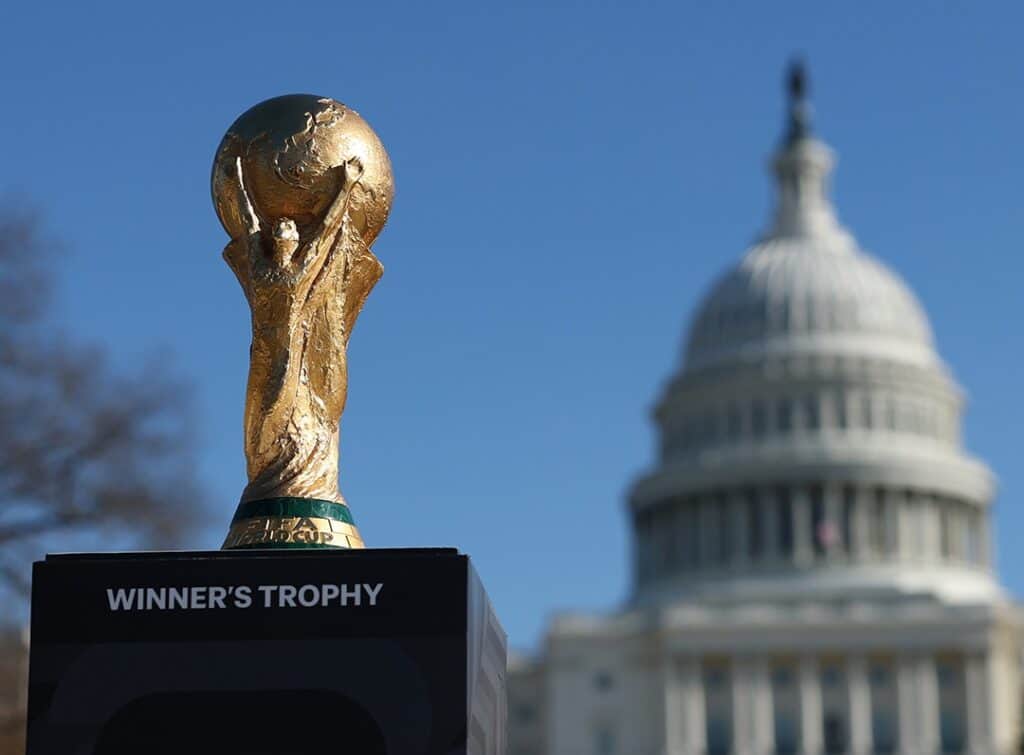
“For every game, no matter where the games are played, no matter if there’s a roof, temperature-wise, there will be a three-minute hydration break. It will be three minutes from whistle to whistle in both halves,” explained Manolo Zubiria, Chief Tournament Officer for the USA at the 2026 World Cup, when announcing the initiative at the World Broadcaster Meeting held in Washington DC. This statement leaves no ambiguity about FIFA’s commitment to implementing the policy universally throughout the tournament.
The decision to apply hydration breaks regardless of conditions represents a significant departure from FIFA’s previous approach, which typically tied such interventions to specific temperature measurements using the wet bulb global temperature system. The old threshold was set at 32 degrees Celsius (89.6 Fahrenheit), with breaks mandated after 30 minutes of play when temperatures exceeded that benchmark. The 2026 World Cup policy eliminates this conditional element entirely, prioritizing consistency and predictability over reactive measures.
Player Welfare Justification
FIFA has framed the mandatory hydration breaks as a player welfare initiative, drawing on lessons learned from recent tournaments where heat and humidity significantly impacted player performance and safety. The 2025 Club World Cup, which took place in the United States during summer months, served as a crucial reference point for this decision. Several matches during that tournament occurred in extreme heat, with temperatures reaching as high as 38 degrees Celsius, prompting complaints from numerous players and managers about impossible playing conditions.
Paris Saint-Germain manager Luis Enrique articulated the challenges during the Club World Cup, stating that “it’s impossible to perform at a very high level for 90 minutes” in such temperatures. His comments reflected broader concerns within the football community about asking elite athletes to maintain peak performance standards in conditions that compromise both safety and quality of play. FIFA responded during that tournament by lowering the temperature threshold for cooling breaks and increasing the availability of water and towels around the pitch perimeter.
The 2026 World Cup represents FIFA’s attempt to proactively address these concerns by building hydration breaks directly into the match structure rather than treating them as reactive measures triggered by specific conditions. By making the breaks universal, FIFA aims to ensure equal treatment for all teams across all matches, eliminating any potential advantages or disadvantages that might arise from some teams receiving breaks while others do not.
Timing and Implementation Details
The hydration breaks during the 2026 World Cup will occur precisely 22 minutes into each half, creating two natural pauses in what has traditionally been continuous play interrupted only by injuries, substitutions, or other unforeseen circumstances. The three-minute duration will be measured “from whistle to whistle,” meaning the referee will blow to stop play at the 22-minute mark and blow again three minutes later to resume the match.
Manolo Zubiria indicated that referees will maintain some flexibility in implementing the breaks if other stoppages occur near the designated time. “Obviously, if there’s an injury at the moment of the 20th or 21st minute and it’s ongoing, this will be addressed on the spot with the referee,” he explained. This provision allows for practical adjustments while maintaining the overall framework of guaranteed breaks in each half.
The positioning of breaks at the 22-minute mark was evidently chosen to divide each 45-minute half into roughly equal segments, providing players with a rest opportunity at the midpoint of their exertion while maintaining sufficient continuous play before and after the interruption. This timing differs from the 30-minute mark used in previous conditional implementations, suggesting FIFA wanted to ensure players receive hydration opportunities earlier in each half.
Tactical Implications for Teams
Beyond the stated player welfare objectives, the introduction of mandatory hydration breaks will fundamentally change tactical approaches during 2026 World Cup matches. Coaches will now have guaranteed opportunities to communicate with their entire team twice during each half, allowing for strategic adjustments that were previously impossible without making substitutions.
This tactical dimension transforms the hydration breaks into something resembling the timeouts common in American sports like basketball and American football. Managers can use these three-minute windows to correct defensive shape, adjust attacking patterns, deliver motivational messages, or respond to opponent tactics that have emerged during the preceding play. Teams that effectively utilize these strategic opportunities may gain significant advantages over opponents who treat the breaks purely as physical recovery periods.
The impact on game management could be particularly significant in knockout stage matches where tactical flexibility often determines outcomes. A team that falls behind early might use the first hydration break to implement changes designed to get back into the match, rather than waiting until halftime or burning a substitution to send tactical instructions onto the pitch.
Broadcasting and Commercial Considerations
While FIFA has emphasized player welfare as the primary justification for mandatory hydration breaks, the announcement’s timing and venue—at the World Broadcaster Meeting—reveals another dimension to the decision. The breaks provide broadcasters with predictable, guaranteed windows for commercial advertisements without missing any match action, addressing long-standing tensions between the continuous nature of football and commercial television’s need for advertising revenue.
The decision followed consultations not only with coaches but also with broadcasters, according to FIFA’s statements. This collaborative approach suggests that commercial considerations played a role alongside player welfare concerns in shaping the policy. For broadcasters, particularly in markets like the United States where commercial breaks are standard during sporting events, the hydration pauses offer valuable opportunities to monetize World Cup coverage more effectively than picture-in-picture advertising or overlay graphics during continuous play.
Critics have pointed to the broadcasting angle as evidence that the hydration breaks represent FIFA’s accommodation of commercial interests rather than purely player-focused decision-making. However, FIFA would likely argue that aligning player welfare initiatives with broadcasting benefits creates a win-win scenario that serves multiple stakeholder interests simultaneously.
Historical Context of Heat Management
Heat has long presented challenges for FIFA World Cups, particularly when tournaments have been hosted in warmer climates or during summer months. The 2014 World Cup in Brazil generated significant controversy over playing conditions, with concerns about extreme heat and humidity in certain venues. A Brazilian court ultimately ordered FIFA to make its recommended breaks mandatory or face financial penalties, demonstrating that legal and regulatory pressures can influence FIFA’s heat management policies.
The 2022 World Cup in Qatar prompted FIFA to take unprecedented action by moving the entire tournament from its traditional summer window to November-December to avoid unbearable desert heat that would have been dangerous for players and potentially unplayable. That decision, while controversial for disrupting domestic league schedules globally, reflected FIFA’s recognition that player welfare sometimes requires dramatic interventions.
The 2026 World Cup hydration breaks represent a different approach—rather than moving the tournament or limiting heat exposure through venue selection and scheduling, FIFA is building rest and recovery directly into match structure to accommodate challenging conditions wherever they occur.
Looking Ahead to 2026 Tournament
The 2026 World Cup will be unprecedented in multiple ways beyond the hydration breaks. The tournament will be the first to feature 48 teams, expanded from 32, creating a longer competition with more matches and greater demands on players. The three-nation hosting arrangement across the United States, Canada, and Mexico presents logistical complexities, though FIFA has designed the match schedule to minimize travel and maximize rest days between matches.
The tournament will feature three opening ceremonies corresponding to each host nation’s first match, with games beginning June 11, 2026, in Mexico City and continuing through the final on July 19, 2026, at New York New Jersey Stadium. That final will include a halftime show for the first time in World Cup history, representing another significant departure from tradition.

As the 2026 World Cup approaches, the mandatory hydration breaks will undoubtedly generate debate among traditionalists who view them as unwelcome interruptions to football’s continuous flow and pragmatists who accept them as necessary adaptations to modern conditions. Regardless of perspective, the breaks will be a defining feature of the tournament, fundamentally altering how the world’s biggest sporting event is experienced by players, coaches, broadcasters, and fans.
Read More: Eder Militao Suffers Biceps Femoris Tear in Left Leg, Out 3-4 Months for Real Madrid
FAQs
How long will hydration breaks last at the 2026 World Cup?
Each hydration break will last exactly three minutes, measured from whistle to whistle. The referee will stop play at the 22-minute mark of each half and resume after three minutes.
Will hydration breaks apply to all 2026 World Cup matches?
Yes, FIFA confirmed that every match will feature hydration breaks regardless of temperature, weather conditions, whether the stadium has a closed roof, or which host country is staging the game.
Why did FIFA introduce mandatory hydration breaks for all matches?
FIFA cites player welfare as the primary reason, drawing on experiences from the 2025 Club World Cup where extreme heat affected player performance. The universal application ensures equal conditions for all teams.
When will the hydration breaks occur during matches?
The breaks will occur at the 22-minute mark of both the first and second halves, effectively dividing each 45-minute half into two segments and turning matches into four-quarter affairs.
Can coaches speak to players during hydration breaks?
Yes, the three-minute breaks will allow coaches to communicate with their entire team and make tactical adjustments, similar to timeouts in other sports, potentially having significant strategic impacts on matches.