

ASUS unveiled its AMD 800 Series motherboard lineup at CES 2026—introducing wireless AIO Q-Connector eliminating pump/fan cables, NitroPath DRAM technology for DDR5 overclocking, optimized PCIe lane layouts enabling five M.2 SSDs with full GPU bandwidth, and AI Cache Boost for LLM workflows.
Table of Contents

AIO Q-Connector: Wireless Cooler Control
The groundbreaking AIO Q-Connector transmits pump, fan, and LCD control signals wirelessly through motherboard contact points—eliminating visible cables that traditionally clutter builds. Compatible with the ROG Strix LC IV Series coolers featuring 5.08-inch full-color displays, this addresses cable management challenges that prioritize clean aesthetics.
Simply align contact points between compatible motherboards and AIO coolers—no headers, no cables. This represents ASUS’s most significant PC building simplification since tool-free M.2 installation, reducing setup complexity while maintaining full cooler control through BIOS and software.
ASUS AMD 800 Series Key Innovations
| Innovation | Feature | Benefit | Target Use |
|---|---|---|---|
| AIO Q-Connector | Wireless pump/fan/LCD control | Cable-free cooler installation | Clean builds |
| NitroPath DRAM | Shorter gold fingers, optimized pathways | Enhanced DDR5 OC headroom | High-frequency memory |
| PCIe Optimization | Shared USB4/M.2 bandwidth | 5x M.2 + full GPU performance | Gaming storage expansion |
| AI Cache Boost | LLM workflow acceleration | Faster local AI tasks | Content creation |
| 64MB BIOS | Expanded capacity | Future AM5 CPU compatibility | Long-term platform |
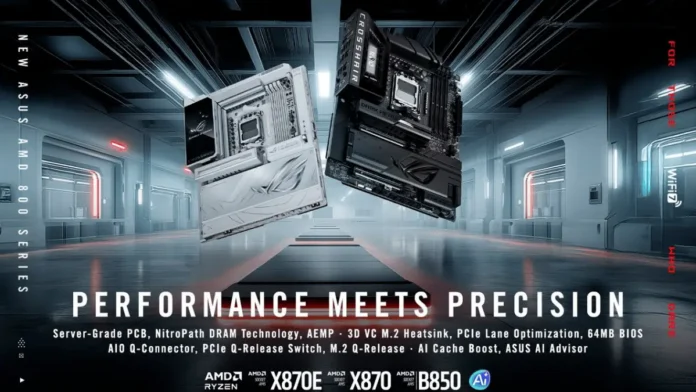
NitroPath DRAM: DDR5 Performance Breakthrough
NitroPath DRAM technology enhances DDR5 memory performance through shorter gold finger pins and optimized signal pathways—ensuring faster data transfers between DRAM and CPU. This translates to greater overclocking headroom and stability for enthusiasts pushing frequency limits.
Server-grade PCB enhancements complement NitroPath: ultra-low-etch manufacturing improves material uniformity and layer flatness, establishing enhanced grounding structures that reduce electrical interference. PCB back drilling optimizes data integrity, 2-ounce copper power planes provide steadier delivery, and 8-layer designs send clean high-speed signals for DDR5 modules and PCIe 5.0 devices.
DIMM Fit Pro analyzes individual memory modules to optimize performance and pinpoint potential issues, while AEMP (ASUS Enhanced Memory Profile) unleashes memory kit potential.
PCIe Lane Optimization: Storage Without Compromise
ASUS optimized PCIe lane layouts addressing real-world user demands—particularly gamers expanding libraries without compromising GPU performance. The ROG Strix X870E-E Gaming WiFi7 Neo enables two PCIe 5.0 M.2 SSDs and three PCIe 4.0 M.2 SSDs while maintaining graphics card PCIe 5.0 x16 mode through intelligent USB4/M.2 bandwidth sharing.
The CES Innovation Award-winning ROG Crosshair X870E Glacial delivers full PCIe 5.0 x16 slot bandwidth, two PCIe 5.0 M.2 slots, and second PCIe slot at 3.0 x4—ideal for high-end gaming/streaming setups using capture cards. Dual PCIe x16 slots support x8/x8 configurations for multi-GPU creative and AI workstations.
4-Rank Memory & AI Features
ASUS partnered with G.SKILL bringing 4-rank memory support to X870E using UDIMM modules. The ROG Crosshair X870E Apex 4-RANK leverages higher per-DIMM capacity suited for data-intensive AI, engineering, and content creation—maintaining strong transfer efficiency and low latency under demanding conditions.
AI features span the lineup:
AI Cache Boost accelerates LLM tasks for local AI workflows. ASUS AI Advisor provides natural-language build assistance powered by AI. AI Overclocking, AI Cooling II, and AI Networking II optimize system performance automatically.
The new MLO Wizard assesses network environments for Multi-Link Operation support across devices, routers, and operating systems—visualizing traffic capacity on each frequency band.

DIY-Friendly Installation Revolution
Beyond wireless AIO control, ASUS simplified PC building through comprehensive Q-series innovations:
PCIe Q-Release Switch (ROG Crosshair X870E Glacial) uses a simple lever controlling two expansion slots—eliminating hard-to-reach plastic latches as heatsinks grew larger. M.2 Q-Release heatsinks, M.2 Q-Latch tool-free installation, and M.2 Q-Slide streamline storage setup.
The 3D vapor chamber M.2 heatsink offers larger dissipation area with tool-free installation for PCIe 5.0 SSDs. ROG Memory Q-Fan snaps magnetically—no screws required—taming high-performance DDR5 heat.
64MB BIOS & Future-Proofing
The higher-capacity 64-megabyte BIOS chip enables more powerful interfaces and extended CPU compatibility with current and future AM5 processors. Pre-installed WiFi drivers enable internet connectivity during Windows installation—no USB flash drives needed for driver setup, streamlining the process.
The ProArt B850-Creator WiFi Neo targets creators, while ROG and TUF Gaming families span X870E, X870, and B850 chipsets supporting Zen 5 Ryzen 9000 Series processors.
Availability: India pricing and availability to be announced. Contact ASUS representatives for details.
FAQs
How does AIO Q-Connector work without cables?
It transmits pump, fan, and LCD control signals wirelessly through aligned contact points between compatible motherboards and AIO coolers.
What makes NitroPath DRAM better for overclocking?
Shorter gold finger pins and optimized signal pathways enable faster CPU-DRAM transfers, providing greater DDR5 overclocking headroom and stability.


