

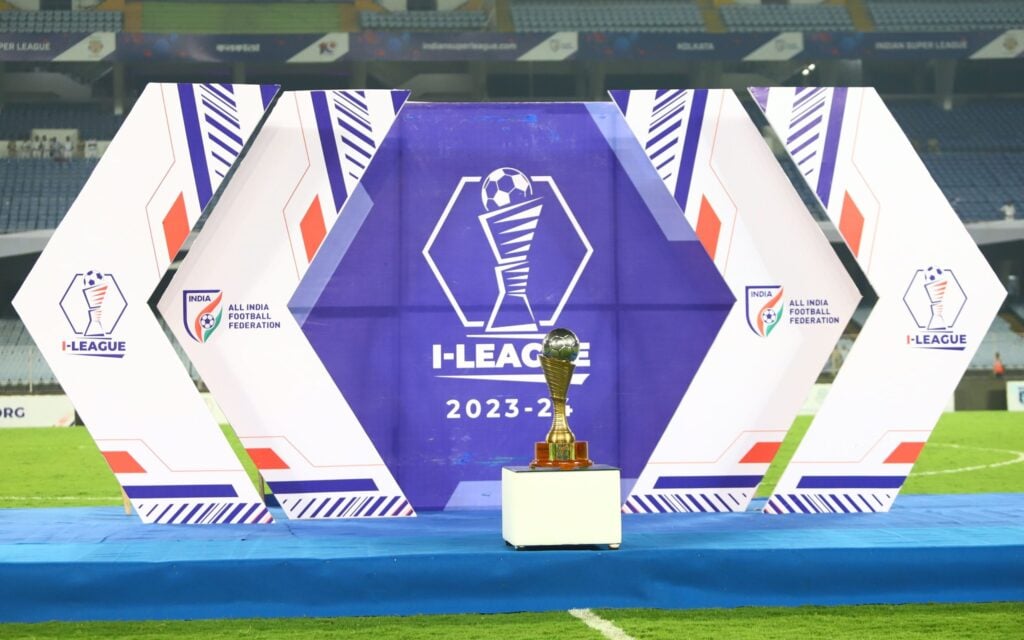
The All India Football Federation has issued a new Request for Proposal for the commercial rights of the I-League, I-League 2, and I-League 3, marking another crucial step in Indian football’s ongoing efforts to secure sustainable commercial partnerships. The AIFF has set December 13, 2025, as the final date for bid submissions, with tender values reflecting the hierarchical structure of Indian football’s second-tier leagues.
Table of Contents
AIFF Sets I-League Tender Values
According to the tender documents released by AIFF, the I-League commercial rights are valued at ₹4 crore, while I-League 2 carries a valuation of ₹1.25 crore, and I-League 3 is priced at ₹75 lakh. These figures represent the federation’s assessment of the commercial potential of India’s second-tier football system, which operates below the Indian Super League in the domestic football pyramid.
The AIFF tender comes at a critical time for Indian football, as the governing body struggles to establish stable commercial partnerships across all levels of the domestic league system. With the ISL tender having failed to attract any bidders in November 2025, the federation faces mounting pressure to successfully monetize its lower-tier competitions to ensure financial sustainability.
I-League Tender Timeline and Requirements
The AIFF has established a comprehensive timeline for the I-League tender process. Interested parties must submit their clarifications via email by December 5, 2025, with a virtual pre-bid conference scheduled for December 6. The deadline for bid submission is set at 17:00 IST on December 13, 2025, after which AIFF will open technical bids on December 14.
The commercial rights being offered through this tender will extend until the end of the 2029-30 season, providing the successful bidder with a five-year partnership with AIFF. This extended timeline is designed to provide stability and allow the commercial partner adequate time to develop and monetize the I-League properties effectively.
AIFF Eligibility Criteria for I-League Bidders
The AIFF has outlined strict eligibility requirements for potential bidders interested in securing the I-League commercial rights. Bidders must be validly incorporated under Indian law, while foreign entities interested in bidding must be incorporated in their respective jurisdictions. If bidding as part of a consortium, the lead member must either be incorporated in India or establish an Indian subsidiary before contract execution with the federation.
One of the most significant requirements is the net worth criterion, which was a major point of contention during the ISL tender process. For the I-League tender, AIFF has set a minimum net worth requirement of ₹30 crores for individual bidders. For consortium bids, the combined net worth must also meet this threshold, representing a substantially lower barrier to entry compared to the ₹250 crore requirement that contributed to the ISL tender’s failure.
| I-League Tender Overview |
|---|
| I-League Rights: ₹4 crore |
| I-League 2 Rights: ₹1.25 crore |
| I-League 3 Rights: ₹75 lakh |
| Bid Submission Deadline: December 13, 2025, 17:00 IST |
| Pre-Bid Conference: December 6, 2025 (Virtual) |
| Contract Duration: Until 2029-30 season |
| Minimum Net Worth: ₹30 crore |
I-League Commercial Rights and Responsibilities
The successful bidder for the I-League tender will receive extensive commercial rights to monetize various aspects of the competitions. These include sponsorship opportunities, broadcast rights, digital media exploitation, advertising, merchandising, and data-related assets across all three I-League divisions. The AIFF has structured the tender to ensure that the rights holder can develop comprehensive commercial strategies across multiple revenue streams.
A critical requirement outlined by AIFF is that the rights holder must ensure live broadcasting of every I-League match. This provision addresses long-standing concerns about inconsistent broadcasting that has plagued the I-League and Indian Women’s League in previous seasons, which has negatively impacted viewer engagement and commercial value.
The tender also includes a Right of First Refusal clause for the successful bidder. AIFF will notify the rights holder twelve months before the contract’s expiration about potential renewal opportunities, giving the existing partner the option to extend their acquisition of commercial rights for an additional period under mutually agreed terms.
AIFF’s Technical Evaluation Process
The AIFF tender incorporates a two-stage evaluation process designed to identify the most capable commercial partner for the I-League. In the first stage, only bidders scoring a minimum of fifty percent in the technical evaluation will progress to the commercial bid evaluation. The technical assessment carries significant weight, with prior experience managing multi-venue sporting events in India accounting for fifteen points out of the total available.
Marketing and promotional spending capabilities will also be evaluated for fifteen points, while the viewership reach of proposed broadcast platforms, whether television channels or streaming services, will contribute ten points to the technical score. This comprehensive evaluation framework ensures that AIFF selects partners with both financial capacity and operational expertise to successfully manage the I-League commercial rights.
Context of Indian Football’s Commercial Crisis
The I-League tender comes against the backdrop of a severe commercial crisis affecting Indian football. In November 2025, AIFF’s tender for ISL commercial rights failed spectacularly when not a single bid was submitted despite initial interest from four organizations, including Football Sports Development Limited, FanCode, Conscient Heritage Group, and a foreign consortium.
The ISL tender failure was attributed to unrealistic financial demands, including a minimum guaranteed payment of ₹37.5 crore annually or five percent of gross revenue, whichever is higher. Industry experts estimated that successful bidders would face minimum annual losses of ₹200-300 crore, making the proposition commercially unviable. This prompted AIFF to adopt a more conservative approach with the I-League tender, setting significantly lower financial thresholds.
Impact on I-League Clubs and Season Uncertainty
The uncertainty surrounding commercial partnerships has had severe consequences for I-League clubs, which operate on considerably tighter budgets than their ISL counterparts. Without confirmed commercial partners and unclear season schedules, clubs have struggled to secure sponsorships, plan operations, and maintain financial stability.
The I-League, which currently serves as India’s second tier following the implementation of promotion and relegation with the ISL, features clubs with deep historical roots in Indian football. Inter Kashi FC are the reigning I-League champions, having won the 2024-25 title and earned promotion to the ISL. The 2025-26 I-League season is scheduled to commence on October 19, 2025, though the absence of a confirmed commercial partner has created operational challenges.
AIFF Faces Mounting Pressure from Stakeholders
The Sports Ministry has stepped in to address the growing crisis in Indian football, calling an urgent multi-stakeholder meeting on December 3, 2025. The meeting will bring together ISL clubs, I-League clubs, FSDL, prospective commercial partners, broadcasters, and OTT platforms to chart a path forward for Indian football’s commercial future.
The Supreme Court of India has also expressed concern over the failed ISL tender and the uncertainty surrounding the 2025-26 season. Justice L Nageswara Rao, appointed by the Supreme Court to oversee the tender process, submitted a report recommending a balance between preserving AIFF’s regulatory authority and creating commercially viable frameworks that can attract genuine investor interest.
Promotion and Relegation in I-League Structure
The I-League tender notably excludes any specific mention of promotion and relegation mechanisms, despite this being a key feature of the league’s current structure. The I-League operates with promotion to the ISL for the champions and relegation to I-League 2 for bottom-placed teams. This system was implemented following the Asian Football Confederation’s roadmap for Indian football, which called for integration of the parallel league systems.

The absence of promotion-relegation details in the tender documents has raised questions among I-League clubs about the structural certainties of the competition. However, AIFF officials have indicated that relegation will proceed according to existing regulations, with ongoing appeals and disputes being resolved through the federation’s disciplinary and appeal committees.
The success of the I-League tender will be crucial for AIFF’s credibility and Indian football’s financial stability. With the ISL tender having failed to attract bidders, all eyes are now on whether the more modestly valued I-League commercial rights can generate interest from potential partners and provide much-needed revenue for the second tier of Indian football.
Read More: Khalid Jamil Wants More OCI Players Like Ryan Williams to Strengthen Indian Football Team
FAQs
What is the deadline for submitting bids for the I-League tender?
The All India Football Federation has set December 13, 2025, at 17:00 IST as the final deadline for bid submissions for the I-League, I-League 2, and I-League 3 commercial rights.
How much is the I-League valued in the AIFF tender?
The AIFF tender values the I-League commercial rights at ₹4 crore, I-League 2 at ₹1.25 crore, and I-League 3 at ₹75 lakh, reflecting the different commercial potentials of each tier.
What is the minimum net worth requirement for I-League bidders?
AIFF has set a minimum net worth requirement of ₹30 crore for bidders interested in acquiring the I-League commercial rights, applicable to both individual bidders and consortiums.
How long will the I-League commercial rights contract last?
The successful bidder will receive commercial rights until the end of the 2029-30 season, providing a five-year partnership period with the All India Football Federation.
Why did the ISL tender fail before the I-League tender was released?
The ISL tender failed because no organizations submitted bids, primarily due to unrealistic financial demands including ₹37.5 crore annual guaranteed payments and projected operational losses of ₹200-300 crore annually, making it commercially unviable for potential partners.