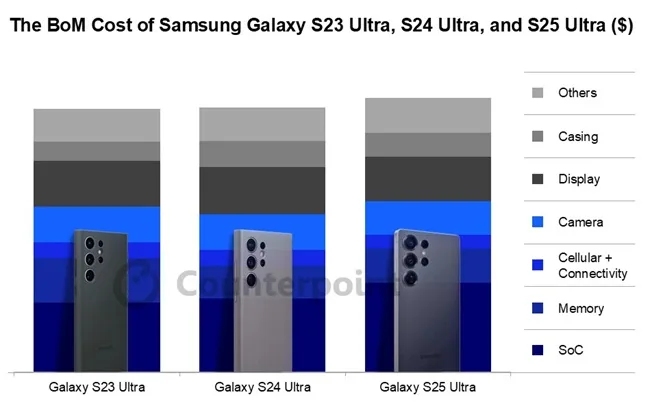
Samsung’s Galaxy S25 Ultra manufacturing costs have increased by 3.4% compared to its predecessor, according to Counterpoint Research. This bill of materials (BoM) analysis reveals how component pricing shifts impact flagship smartphone economics.

Table of Contents
Cost Breakdown: Winners and Losers
| Component | S24 Ultra vs S23 Ultra | S25 Ultra vs S24 Ultra |
|---|---|---|
| SoC | Moderate increase | +21% (biggest driver) |
| Memory | Declined | Slight increase |
| Casing | +32% (titanium switch) | -8% (production efficiency) |
| Display | +4% (brightness upgrade) | Slight decrease |
| Camera | Balanced (zoom trade-off) | -8% (component maturity) |
| RF Components | Significant decline | -10%+ (5G maturity) |
SoC: The Major Cost Driver
The Snapdragon 8 Gen 4 “Elite” processor represents the largest expense increase, jumping 21% from the S24 Ultra. This premium stems from:
- Advanced TSMC N3E manufacturing process
- 16 billion transistor integration
- Qualcomm’s custom Oryon CPU architecture
- Enhanced performance and efficiency gains
The chip transition from Snapdragon 8 Gen 2 to Gen 4 Elite reflects Samsung’s commitment to cutting-edge performance despite rising costs.
Titanium Framework Optimization
While the S24 Ultra’s titanium adoption initially spiked casing costs by 32%, Samsung achieved an 8% reduction in the S25 Ultra through improved production techniques. This demonstrates how manufacturers optimize expensive materials over successive generations.
Display and Camera Efficiencies
The S25 Ultra benefits from declining OLED panel prices and mature camera component costs. The ultrawide sensor upgrade to 50MP from 12MP came with overall camera cost reductions of 8%.
Industry Implications
This BoM analysis highlights how flagship smartphones balance innovation costs with manufacturing efficiency. The S25 Ultra’s price structure may influence future Samsung pricing strategies as component costs stabilize.

The 3.4% increase primarily reflects advanced processor investments while other components achieve cost optimization through production maturity.