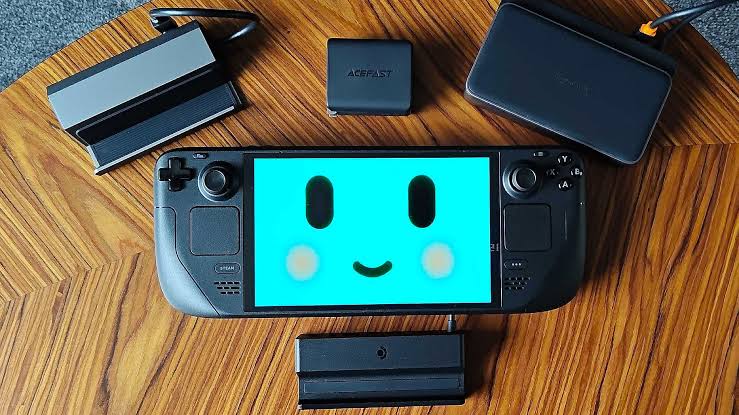
On February 25, 2022, Valve shipped the Steam Deck. The result was a $399 handheld that finally put a sprawling PC game library in a device you could play almost anywhere.
The Steam Deck still rewards owners who understand its PC roots. Its most useful features go beyond graphics performance: game compatibility, quick suspension, flexible controls, desktop access, and expandable storage all matter. “A powerful handheld gaming PC with console-like controls” remains the clearest way to describe what Valve built.
Steam Deck features start with SteamOS and game compatibility
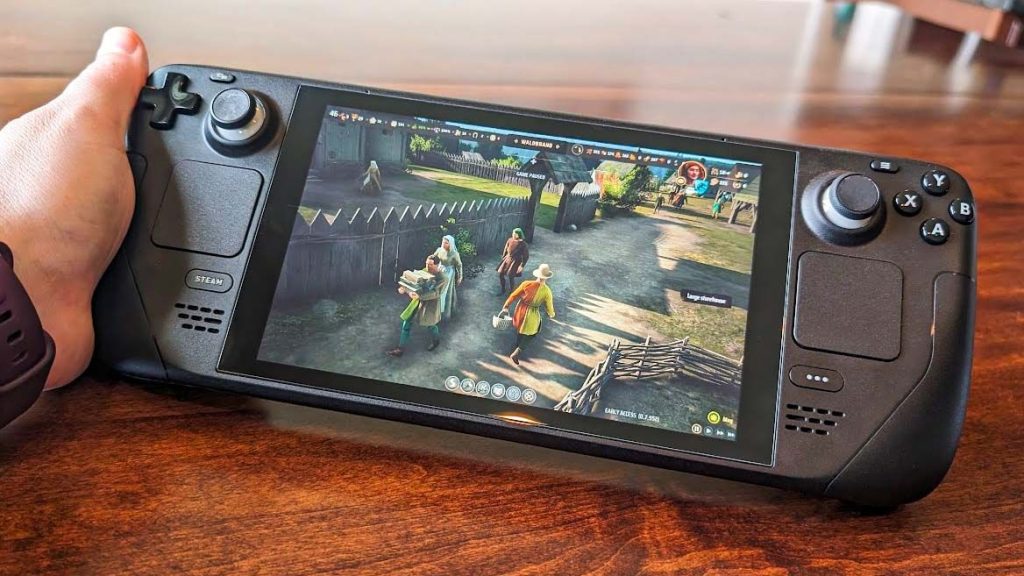
The first feature every new owner should learn is SteamOS, the Linux-based interface that makes a PC game library feel more like a console catalogue. Valve’s verification system gives games compatibility information, helping users find titles that should work well with the handheld’s controls, display, and operation.
Five Steam Deck features that affect daily play
The Steam Deck’s second major feature is quick suspension. Press the power button, and the system pauses your session so you can return later without restarting the game from its opening screen. That matters more on a handheld than on a desktop PC, where short play sessions are less common.
The third feature is control flexibility. Alongside analogue sticks, buttons, triggers, and a touchscreen, the Steam Deck includes trackpads for cursor movement, strategy games, menus, and titles designed around a mouse. You can also adjust button layouts, giving you a way to adapt the controls instead of abandoning a difficult-to-use game.
Desktop mode is the fourth feature worth learning; it opens a more traditional PC environment for managing files, installing compatible software, adjusting settings, or using the Steam Deck beyond gaming. New owners should see it as an optional power-user layer, not a requirement for ordinary play. The fifth feature is expandable storage: launch options included 64 GB eMMC, 256 GB NVMe SSD, and 512 GB NVMe SSD configurations, while a compatible microSD card can add space for games.
That extra space matters because modern PC games can consume tens of gigabytes, making the base storage configuration restrictive for a large library. For more detail, see Gizmodo.
Steam Deck specifications explain the experience
The Steam Deck uses an AMD APU with a Zen 2 CPU and rdna 2 GPU, supported by 16 GB of LPDDR5 RAM. Its display is a 7-inch IPS LCD panel with a 1280 x 800 resolution, which suits portable gaming without demanding the same rendering load as a higher-resolution screen.
The original Steam Deck’s battery capacity is listed as 40 Whr, although the supplied specifications don’t officially confirm that figure. Battery life can change sharply with game workload, brightness, frame-rate settings, and wireless use, so learn the performance and battery controls before taking the handheld on a long journey.
| Steam Deck specification | Confirmed detail |
|---|---|
| Processor platform | AMD APU with Zen 2 CPU and rdna 2 GPU |
| Memory | 16 GB LPDDR5 RAM |
| Display | 7-inch IPS LCD |
| Resolution | 1280 x 800 |
| Launch storage | 64 GB eMMC, 256 GB NVMe SSD, or 512 GB NVMe SSD |
What new Steam Deck owners should do next
Start with one familiar game and use it to learn SteamOS, suspension, control mapping, and performance settings. This approach reveals more than immediately downloading several demanding titles. Valve’s original $399 entry point made the Steam Deck a lower-cost route into portable PC gaming, but storage and software familiarity determine how practical that entry point becomes.
FAQs
Is the Steam Deck a console or a PC?
The Steam Deck is a handheld gaming PC that uses SteamOS and supports a desktop environment alongside console-style controls.
What processor does the Steam Deck use?
The Steam Deck uses an AMD APU featuring a Zen 2 CPU and rdna 2 GPU.
How much RAM does the Steam Deck have?
Every Steam Deck configuration features 16 GB of LPDDR5 RAM.
What screen does the Steam Deck use?
The Steam Deck has a 7-inch IPS LCD display with a 1280 x 800 resolution.
Can Steam Deck storage be expanded?
Yes. Owners can use a compatible microSD card to add storage beyond the 64 GB, 256 GB, or 512 GB launch configurations.
Was this article helpful?
Your feedback directly improves future articles on this site.