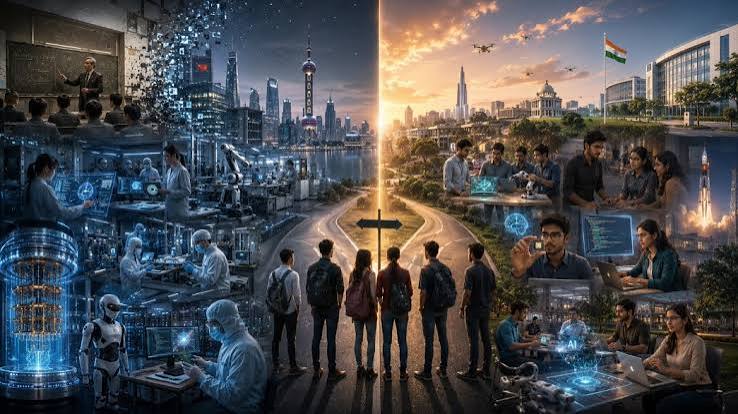
A reported 12,200 undergraduate programmes were closed or paused between 2021 and 2025, showing how quickly artificial Intelligence is reshaping higher education in China. On Wednesday, September 23, 2026, Chinese universities were reported to be removing or merging degrees in translation, photography, illustration and fashion design, while film is gaining a new prompt-engineering specialisation.
The 12,200-programme reset
The closures and pauses reportedly affected more than 30% of undergraduate programmes nationwide between 2021 and 2025. Universities reportedly opened roughly 10,200 new programmes during the same period, redirecting capacity towards chips, robotics and AI-related industries that the state considers strategically important.
The shift is not limited to one campus or one subject area. Arts, humanities and language courses absorbed the heaviest reductions, placing pressure on degrees whose traditional career paths depend on work that generative AI can now produce, translate or modify at lower cost. A survey covering 70 universities reportedly found that five translation majors, eight Japanese majors and five German majors had been cut. Those figures suggest that language education is being judged increasingly by employment demand rather than by its long-standing academic role.
Why creative degrees are under pressure
The Central Academy of Fine Arts reportedly dropped courses in illustration, photography and translation as part of this wider reassessment. The logic is not that creative work has disappeared, but that entry-level production tasks can now be completed with image generators, editing systems and language models.
Photography programmes are reportedly being merged as automated image creation changes commercial production. Illustration faces a similar challenge because studios can use AI tools for concept exploration, visual variations and rapid revisions before human artists handle direction, selection and refinement. Fashion design is also reportedly being cut at some universities. The replacement model places greater emphasis on cooperation between people and machines, suggesting that students may need to combine taste, cultural knowledge and design judgement with AI-assisted production.
| Area | Reported change | What it signals |
|---|---|---|
| Translation | Five majors reportedly cut in a 70-university survey | Pressure on language careers |
| Japanese | Eight majors reportedly cut | Falling demand for some specialist programmes |
| German | Five majors reportedly cut | Employment value is being reassessed |
| Photography | Programmes reportedly merged or dropped | AI is changing image production |
| Fashion design | Degrees reportedly scrapped at some universities | Human-machine collaboration is gaining weight |
Prompt engineering enters film
The most unusual development is the reported arrival of prompt engineering as a film-industry job specialisation. The role is connected to the use of generative systems in creative production and is described as replacing some traditional vocational positions, although the specific employment structure remains unconfirmed. For more detail, see VentureBeat AI.
Prompt engineers in film would likely need to translate creative instructions into usable directions for AI systems, maintain visual consistency and revise outputs against a director’s brief. That work differs from simply writing prompts because production requires continuity, timing, character control and repeated collaboration across departments. The change also raises a training question. Film schools may need to teach model behaviour, prompt design and visual evaluation alongside cinematography, editing and storytelling. Skills such as Prompt Caching, Explained could become relevant when creative teams manage repeated AI requests at scale.
What students and employers should watch
Students choosing a degree now face a harder calculation than course reputation alone. A traditional qualification in translation, illustration or photography may still lead to work, but employers are likely to value portfolios that show AI-assisted production, editorial judgement and the ability to supervise automated systems. Universities are also being pushed towards shorter feedback cycles.
A course designed around one tool can age quickly, while training in storytelling, languages, visual judgement and technical adaptability can remain useful as software changes. The next stage will test whether prompt engineering becomes a durable profession or an interim label for duties absorbed by directors, editors and designers. The immediate lesson is clearer: degrees built around narrow production tasks face the greatest pressure, while hybrid courses linking human judgement with AI systems are gaining ground. China’s degree cuts show that AI is changing not only jobs but the university subjects created to prepare people for them. Source: Techradar
FAQs
Which degrees are being removed or reduced?
Translation, photography, illustration and fashion design programmes are among the traditional courses being removed, merged or reassessed.
How many university programmes were affected?
Universities reportedly closed or paused 12,200 undergraduate programmes between 2021 and 2025 and launched about 10,200 new programmes.
Is prompt engineering confirmed as a film job?
Prompt engineering has emerged as a reported film specialisation, but the details of its employment structure remain unconfirmed.
What should students study instead?
Students can consider hybrid courses that combine creative judgement, technical skills, AI-assisted production and industry-specific knowledge.
Was this article helpful?
Your feedback directly improves future articles on this site.