

OpenAI launched the original ChatGPT on November 30, 2022, utilizing the GPT-3.5 architecture for static text prompts. That first web release kicked off modern consumer artificial intelligence, attracting millions of users in just a few weeks.
Users interacted solely through typed commands. The foundational system couldn’t handle images or voice inputs, processing only string tokens via the official OpenAI architecture updates.
On May 13, 2024, OpenAI officially announced the GPT-4o multimodal model. This advancement allowed for real-time audio, vision, and text processing. This architectural change got rid of the delays tied to chained pipelines, merging modalities into a single neural network.
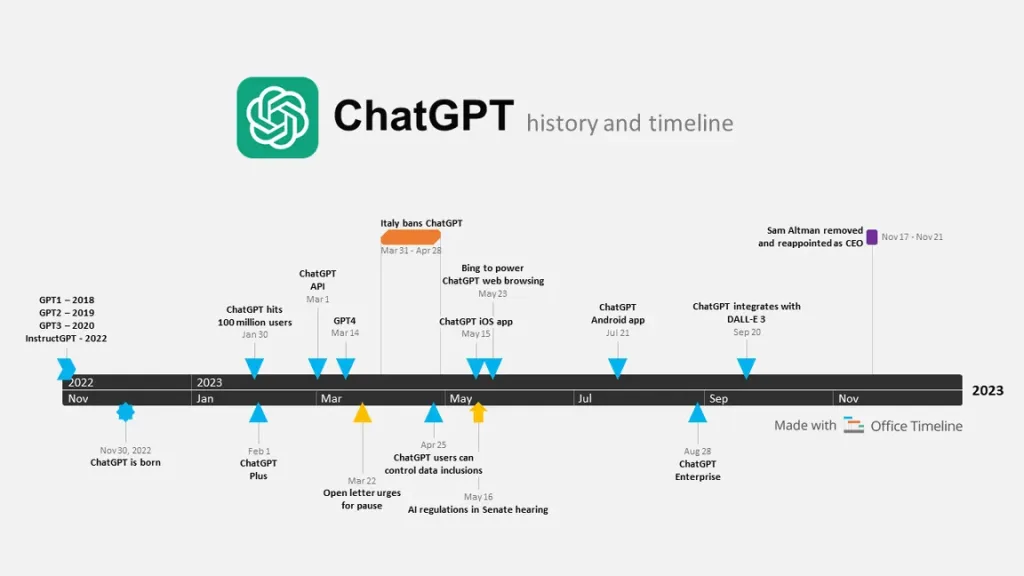
Tracing ChatGPT Evolution: Key Architecture Milestones and Context Expansion
The GPT-4o model features an expanded context window of 128,000 tokens, making it capable of processing large text and multimodal inputs. Developers could suddenly input entire code repositories or hundreds of pages of documentation in one prompt without losing historical context.
This increased capacity significantly cut down the need for complex retrieval systems in lightweight enterprise workflows. Competitors like Anthropic and Google rushed to match or exceed these token limits in their own models.
Voice processing evolved alongside text capacity. On November 21, 2024, OpenAI rolled out advanced voice capabilities in ChatGPT for all free users worldwide. Conversations with AI shifted from awkward speech-to-text transcription to smooth, low-latency spoken dialogues complete with emotional inflection.
Vision processing followed a similar path, evolving from basic image descriptions to real-time spatial analysis using smartphone cameras. Users could now point their cameras at whiteboard sketches or complicated math equations and receive immediate, visual step-by-step help.
Transition Toward Autonomous Agent Workflows
Static prompts and real-time multimodal chats laid the groundwork for the next big leap in software automation. OpenAI introduced the Operator autonomous agent preview in January 2025 unconfirmed, designed to handle multi-step web browser tasks on its own.
Now, instead of just answering questions about flight schedules, an autonomous agent can log into a portal, pick seats, and complete transactions. This shift transforms AI from a passive advisory tool into an active digital worker.
As autonomous capabilities matured across cloud platforms, enterprise adoption metrics changed rapidly. Chief technology officers began swapping out custom macro scripts for agentic workflows that could handle exception states dynamically.
| Release Date | Model / Milestone | Core Capability |
|---|---|---|
| November 30, 2022 | ChatGPT (GPT-3.5) | Static text prompts and basic conversational memory |
| February 2023 | ChatGPT Plus | Commercial tier introduced at $20 per month |
| May 13, 2024 | GPT-4o | Native real-time multimodal audio, vision, and text |
| January 2025 | Operator Preview | Autonomous multi-step web browser execution |
Industry Impact and Regional Pricing Dynamics
Market reception varied by region due to local currency values and regulatory frameworks. In the United States, the $20 baseline remained standard, while India saw localized billing adjustments based on regional purchasing power.
Security researchers cautioned that autonomous agents could introduce new vulnerabilities for corporate networks. Malicious web pages might hijack an unmonitored browser agent executing automated form submissions.
Developers are working hard to refine safety boundaries to prevent unauthorized data breaches during autonomous execution cycles. Regulatory bodies in Europe and North America are drafting compliance mandates specifically targeting autonomous software agents.
Future systems will likely focus on deep reasoning capabilities before diving into multi-app workflows. Industry watchers expect to see more cross-platform API integrations within consumer tiers by late 2026.
Tracing ChatGPT’s evolution shows how quickly artificial intelligence has moved from a text novelty to an essential part of everyday life.
Related Articles
FAQs
When was the original ChatGPT launched?
OpenAI launched the original ChatGPT on November 30, 2022, utilizing the GPT-3.5 architecture for static text prompt interactions.
What is the context window of the GPT-4o model?
The GPT-4o model supports a context window of 128,000 tokens for handling extensive text documents and multimodal inputs.
How much did ChatGPT Plus cost at launch?
The ChatGPT Plus subscription plan debuted at a
What is an autonomous multimodal agent?
An autonomous multimodal agent can process text, audio, and vision while independently executing multi-step tasks like web browsing or booking.


