For years, Apple’s greatest competitive advantage was that it controlled everything. The chip. The software. The AI. Today, at WWDC 2026, it gave one of the most important pieces away.
Apple’s annual developer conference is usually a celebration. On Monday, it turned into a reckoning. Within hours of the keynote concluding, Apple’s market capitalisation had shed approximately $230 billion — one of the largest single-day value wipeouts in the company’s history. The trigger wasn’t a product failure or a profit warning. It was a strategic admission hidden inside a feature announcement: Apple’s new Siri runs on Google’s Gemini.
The features shown at WWDC 2026 were genuinely impressive. The source of half of them is what the market couldn’t forgive.
Table of Contents
WWDC 2026: Everything Announced at a Glance
| Announcement | Detail |
|---|---|
| New Siri AI Engine | Powered by Google Gemini |
| Availability | Not available in EU or China at launch |
| iOS 27 Support | Back to iPhone 11 |
| App Launch Speed | 30% faster |
| AirDrop Speed | 80% faster |
| Siri Screen Reading | Reads your screen contextually |
| Siri Camera Identification | Identifies objects via camera |
| Siri Voice Ordering | Orders food by voice |
| Kid Accounts | Built-in parental controls |
| Built-in Calendar | Native app replacing third-party tools |
| Market Cap Lost | ~$230 billion within hours of keynote |
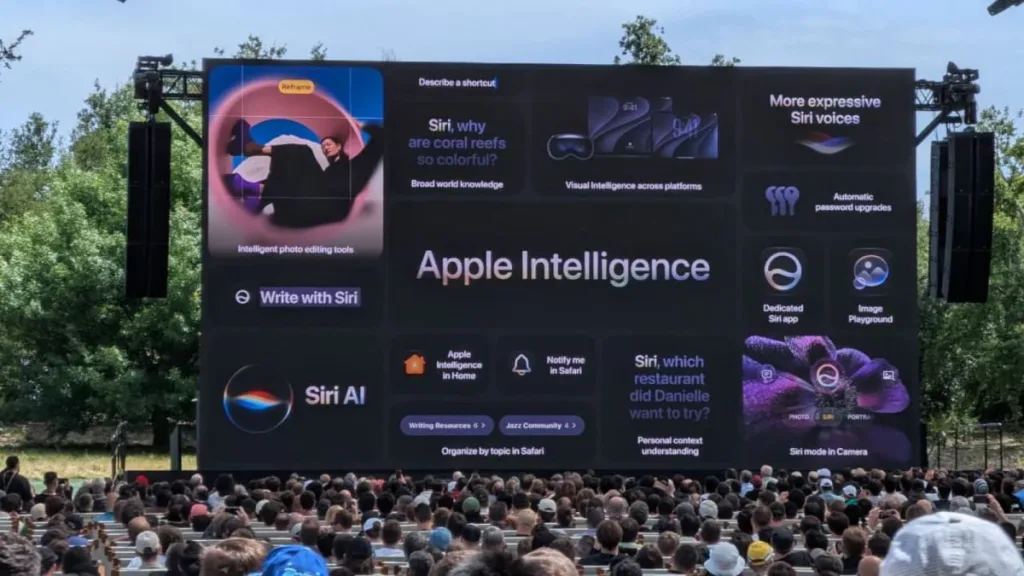
The Headline That Hurt: Siri Now Runs on Google Gemini
Let’s be direct about what this means, because the framing matters enormously.
Apple did not “integrate” Gemini as a secondary option the way it previously offered ChatGPT as an opt-in assistant. The new Siri — Apple’s primary voice and AI interface, the product that has been Apple’s face of artificial intelligence since 2011 — now runs on Google’s Gemini as its core AI engine.
For a company that has spent years telling investors, developers, and consumers that its on-device AI approach was superior, more private, and more capable than cloud-dependent alternatives, this is a significant philosophical reversal. Apple has effectively acknowledged that its own AI development has not kept pace with what Google, OpenAI, and Anthropic have built — and that rather than delay the product further, it chose to license a competitor’s technology instead.
The market read it the same way. A $230 billion market cap destruction in a single session is not a reaction to features — it is a reaction to what those features imply about Apple’s competitive position in the most important technology race of this decade.
For our previous coverage of where the AI model race currently stands, read our AI and technology coverage on TechnoSports.
The EU and China Problem: Siri’s Biggest Markets Are Locked Out
The new Gemini-powered Siri won’t be available in the European Union or China at launch — and that geographic exclusion is not a footnote. It is a material business problem.
The EU exclusion almost certainly reflects regulatory friction around the Google-Apple AI arrangement — the same framework that has made other Apple AI features rocky in Europe under the Digital Markets Act. The China exclusion is a separate but equally serious issue: Gemini is not licensed or approved for deployment in China, meaning Apple’s flagship AI feature launches without its second-largest market.
Combined, the EU and China represent a significant portion of Apple’s global iPhone revenue. Launching a marquee feature that is unavailable to a substantial share of your customer base is a product strategy problem that goes beyond software — it raises questions about Apple’s ability to offer a unified, globally consistent AI experience.

What Was Actually Great at WWDC 2026
To be fair to Apple, several announcements at WWDC 2026 were genuinely excellent — and deserve coverage on their own merits.
iOS 27 back to iPhone 11 is a remarkably generous compatibility window. Supporting a seven-year-old device with a major OS update is unusual in the smartphone industry, and it extends meaningful software longevity to a large installed base of older iPhone owners still using perfectly functional hardware.
30% faster app launches and 80% faster AirDrop are the kind of under-the-hood improvements that don’t make for exciting demo moments but profoundly affect the daily feel of the platform. AirDrop at 80% improved speed is genuinely transformative for anyone who regularly shares large files between Apple devices.
Siri reading your screen and identifying what your camera sees are compelling capabilities — contextual awareness that turns Siri from a command-response tool into something closer to a genuine ambient assistant. Food ordering by voice extends that into practical utility.
Kid Accounts and a native Calendar fill genuine gaps in Apple’s ecosystem — particularly Kid Accounts, which replaces a patchwork of parental control workarounds with a proper first-party solution.
The features, in isolation, would have been celebrated. The Gemini revelation reframed everything.
What This Means for the Broader AI Race
Apple’s WWDC 2026 announcement has immediate ripple effects across the competitive landscape.
For Google: Gemini is now the AI engine inside the world’s most valuable consumer device ecosystem. The distribution advantage this creates for Google’s AI ambitions is enormous — hundreds of millions of iPhone users will interact with Gemini-powered Siri daily, providing both revenue and data advantages that no other AI partnership currently matches.
For Apple: The strategic question is whether this is a temporary bridge — buying time while Apple’s own AI models mature — or a longer-term dependency that permanently cedes the AI layer of its platform to a competitor. History suggests Apple prefers to own its critical technology stacks. Whether it can close the gap to Google, OpenAI, and Anthropic quickly enough to do so remains genuinely uncertain.
For Samsung and Android: Apple’s AI admission gives Android manufacturers a legitimate talking point for the first time in years — that their Gemini integration is native and global, while Apple’s is licensed and geographically restricted.
We recently covered Google’s Gemma 4 12B launch and Anthropic’s recursive self-improvement report — both of which provide crucial context for understanding exactly how far ahead of Apple the AI frontier has moved. Also worth reading: our breakdown of the Claude Mythos leak for the full picture of where the AI race stands heading into the second half of 2026.
Analysis based on Apple WWDC 2026 keynote announcements and market data from June 9, 2026. Market cap figures are approximate based on intraday trading data.