

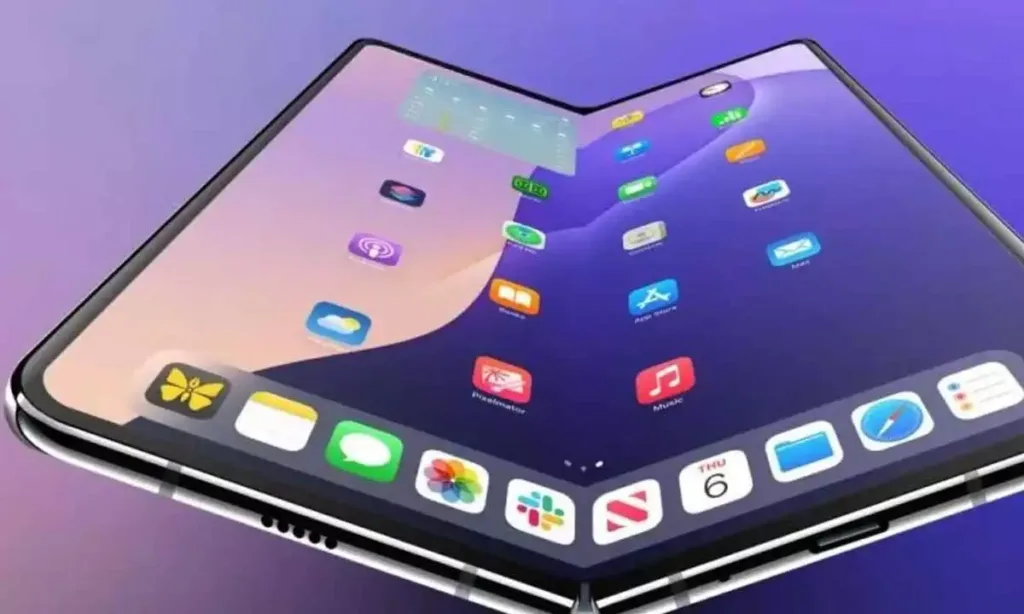
The foldable iPhone Fold is no longer a rumor. It’s in production. According to multiple supply-chain reports and analyst confirmations, Apple’s iPhone Fold has officially entered mass production, with a fall 2026 launch now essentially confirmed. And the specs that just leaked? They’re exactly what Apple needed to pull off to actually compete with Samsung’s Galaxy Z Fold dynasty.
Table of Contents
iPhone Fold: The Specs That Matter
Here’s what we’re getting when the iPhone Fold ships this fall:
| Spec | Details |
|---|---|
| Folded Thickness | 9–9.5mm |
| Unfolded Thickness | 4.5–4.8mm (thinner than iPhone Air) |
| Frame Material | Titanium alloy |
| Hinge Construction | Titanium alloy + Austenitic 304 stainless steel + Liquid Metal |
| Inner Display | 7.76-inch OLED (2,713×1,920, 120Hz LTPO) |
| Outer Display | 5.49-inch OLED (2,088×1,422, 120Hz LTPO) |
| Authentication | Touch ID (side-mounted, iPad Air-style) |
| Camera Setup | Dual 48MP rear, front camera, inner display camera |
| Crease Status | Virtually crease-free (metal plate stress distribution) |
The standout number? 4.5–4.8mm unfolded. That makes the iPhone Fold, when open, Apple’s thinnest device ever — beating even the 12.9-inch iPad Pro (5.1mm) and significantly thinner than the 5.6mm iPhone Air. Two screens, a complex hinge, batteries, cameras, all packed into something 20% thinner than a single-screen phone.
That’s not incremental engineering. That’s Apple flexing.

The Crease Problem — Solved?
Every foldable phone has the same Achilles heel: the crease. Samsung’s Z Fold 6 has it. Google’s Pixel Fold has it. OnePlus, Oppo, everyone. It’s the visual reminder that you’re using a compromised display.
Apple reportedly cracked it. According to analyst Ming-Chi Kuo and Chinese supply-chain sources, the iPhone Fold uses a laser-drilled metal support plate beneath the OLED that disperses bending stress when folding. Combined with the Liquid Metal hinge (Apple’s first major use of the material in a mechanical component), the result is a display that’s allegedly crease-free or near-invisible crease.
If true, this alone justifies the years of delay. Samsung showcased similar crease-reduction tech at CES 2026 as an “R&D concept,” but Apple is reportedly shipping it as production-ready hardware this fall.
Liquid Metal Hinge: Apple’s Secret Weapon
Liquid Metal — technically Liquidmetal, an amorphous metal alloy — has been in Apple’s patent portfolio since a 2010 licensing deal with Liquidmetal Technologies. Apple’s used it for trivial components (SIM ejector tools), but never anything structural.
Until now.
Liquid Metal is 2.5x stronger than titanium alloy, more resistant to bending and deformation, and critically: it has spring-like fatigue resistance. For a hinge that will endure hundreds of thousands of open-close cycles, that matters enormously. The material’s lack of crystalline structure means it won’t develop micro-fractures the way traditional metals do under repeated stress.
The hinge itself is a hybrid: titanium alloy + austenitic 304 stainless steel + Liquid Metal components. This combination gives Apple structural strength (titanium), corrosion resistance (stainless steel), and fatigue resistance (Liquid Metal) — the holy trinity of foldable durability.
The Software Question: iOS Meets iPadOS
Apple’s hardware is clearly ready. The bigger unknown is software. How does iOS handle a 7.76-inch display that needs to split-screen apps, float windows, and handle multitasking without confusing users who expect iPhone simplicity?
Mark Gurman reports Apple is dedicating major resources to iOS 27 (launching fall 2026 alongside the Fold) specifically for foldable features. The challenge: bridge the gap between iPhone’s simplicity and iPad’s productivity without creating a Franken-OS.
Early leaks suggest Apple’s approach involves:
- Adaptive UI: Apps automatically scale and rearrange based on folded/unfolded state
- Split-screen refinement: Better than iPad’s current implementation
- Continuity enhancements: Seamlessly transition tasks from outer to inner display
- Keyboard intelligence: Context-aware input methods for different screen states
The outer 5.49-inch display is sized to work as a regular iPhone when folded — not a compromised secondary screen like some competitors offer. That’s important for usability.

The Ecosystem Advantage Apple Isn’t Talking About
Here’s what Apple naturally holds over Samsung, Google, and every Android foldable: ecosystem lock-in. If you own AirPods, an Apple Watch, a MacBook, and an iPad, the iPhone Fold becomes the perfect device to tie them all together.
Handoff between the Fold’s outer screen and your Mac. Universal Control spanning the unfolded Fold and an iPad Pro. Seamless transition between the outer display for quick tasks and inner display for productivity. Apple doesn’t need to invent new features — it just needs to extend existing ones to a foldable form factor.
For Indian consumers and Apple loyalists, this matters: the iPhone Fold isn’t asking you to choose between an iPhone and an iPad. It’s both, with the ecosystem you already invested in.
Pricing: The $2,000+ Elephant in the Room
No official pricing yet, but analysts peg the iPhone Fold between $1,999–$2,299. For context:
- iPhone 17 Pro Max: ~$1,199
- Samsung Galaxy Z Fold 6: ~$1,899
- iPad mini + iPhone 17: ~$1,698 combined
At $2,000+, the Fold is positioned as a luxury productivity device, not a mainstream phone. Initial production volume is reportedly 6-8 million units — modest compared to the 80+ million iPhone 17 units Apple typically ships.
This is a halo product. A statement. A test bed for future foldable iPads and hybrid devices.
The Fall 2026 Timeline Is Real
Mass production starting now means a September–October 2026 launch alongside the iPhone 18 series. Apple’s March 4 event will focus on the budget MacBook and Studio Displays — the Fold gets its own stage later.
Some analysts still flag a potential slip to early 2027 if Apple encounters last-minute hinge or display durability issues. But with production ramping now, barring catastrophe, fall 2026 is happening.
Follow the latest iPhone Fold updates, foldable phone trends, and Apple hardware launches at Technosports.


