Apple’s A20 and A20 Pro chips represent the company’s first leap to TSMC’s 2nm process, bringing revolutionary packaging technology and performance improvements for the iPhone 18 lineup launching September 2026. These advances combine cutting-edge lithography with architectural innovations that could redefine smartphone capabilities.
Table of Contents
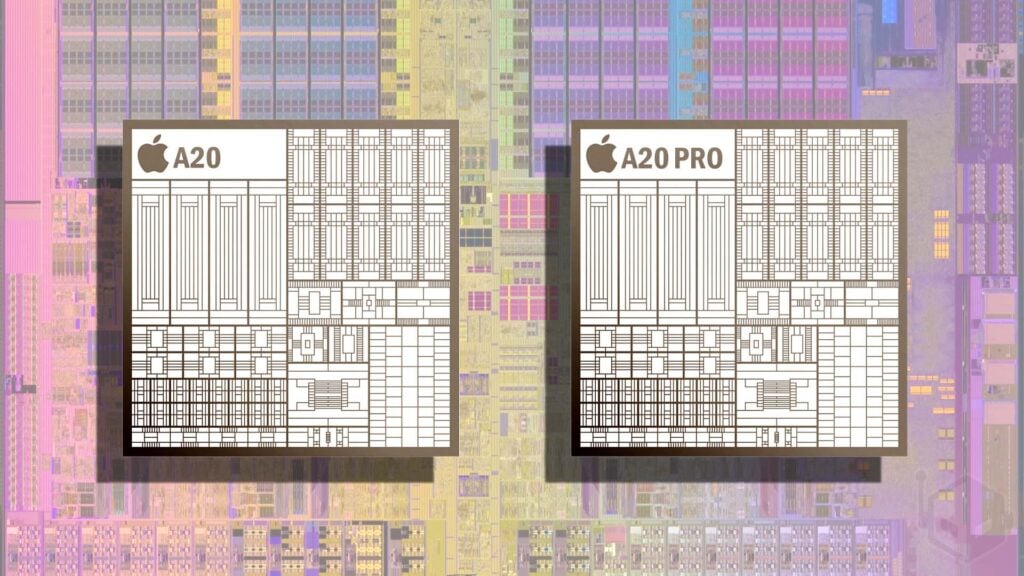
A20 and A20 Pro Key Technological Advances
| Innovation | Details | Benefits |
|---|---|---|
| Manufacturing Process | TSMC 2nm N2 (GAA transistors) | 15% faster performance, 30% better efficiency vs A19 |
| Packaging Technology | WMCM (Wafer-Level Multi-Chip Module) | Replaces InFO, integrates RAM directly on chip wafer |
| Chip Size | Smaller footprint vs current chips | Enables thinner devices, larger batteries |
| Thermal Management | Improved heat dissipation | Better sustained performance, cooler operation |
| 3rd-Gen Dynamic Cache | Larger SLC cache expected | Smoother emulated gaming, improved AI tasks |
| Performance Core L2 Bandwidth | Likely exceeds A19 Pro’s 120GB/s | Enhanced memory bandwidth for intensive workloads |
| Target Devices | iPhone 18 Pro/Pro Max, iPhone Fold | A20 Pro for flagships, standard A20 for base models |
| Production Timeline | Mass production late 2025 | Launch September 2026 with iPhone 18 series |
WMCM Packaging: The Game-Changer
The shift from Integrated Fan-Out (InFO) to WMCM packaging marks Apple’s biggest architectural change in years. WMCM integrates CPU, GPU, Neural Engine, and RAM directly onto the chip wafer at the wafer level, eliminating the silicon interposer entirely. This reduces manufacturing complexity while improving component communication speeds.
Streamlined production using MUF (Molding Underfill) reduces material consumption and process steps, helping offset TSMC’s estimated $30,000 per 2nm wafer cost. Higher yields with fewer defective chips enable Apple to scale production volumes while maintaining quality standards.

Performance and Efficiency Gains
The 2nm GAA (Gate-All-Around) transistor architecture delivers approximately 15% performance improvements over the A19 Pro while consuming 30% less power. This efficiency leap could enable thinner iPhone designs like the second-generation iPhone Air or extend battery life significantly without increasing battery capacity.
Apple has secured over half of TSMC’s initial 2nm production capacity, keeping competitors like Qualcomm and MediaTek waiting. The A19 Pro already demonstrated incredible efficiency core performance at near-zero power consumption, and the A20 should amplify these gains substantially.
For comprehensive iPhone news and chip technology analysis, visit TechnoSports.
FAQs
When will Apple release the A20 and A20 Pro chips?
September 2026 with the iPhone 18 series; TSMC begins mass 2nm production late 2025 to meet Apple’s timeline.
What’s the main advantage of WMCM packaging?
WMCM integrates RAM directly onto the chip wafer, reducing size, improving efficiency, and enhancing thermal management for thinner iPhones.